05
1950-1959
Citizenship, Deep Roots, and the Consolidation of the Gerstel Office
The legal transition of Dietrich and Irmgard Gerstel from statelessness to obtaining Venezuelan citizenship. At the same time, their accounting firm grew steadily throughout the 1950s, becoming the leading German-speaking tax consulting firm in Caracas and establishing Dietrich as a business leader of the era.
From Stateless Persons to Venezuelan Citizens
After leaving Germany in 1939 and being stripped of his nationality under Reich laws in 1941, Dietrich and his wife Irmgard found themselves in a painful legal limbo. In a letter from 1946, he himself detailed his residency history under a devastating condition: that of a stateless person. Without the backing of a state, a passport, or a system to validate his existence, Dietrich was a man without a homeland, but with the firm determination to forge his own destiny in a new land.
This situation of helplessness took a decisive turn on August 3, 1946, when the Official Gazette of Venezuela published a resolution exempting a specific list of refugees from the control decrees of the Revolutionary Governing Junta. By no longer considering them “German citizens,” the Venezuelan government recognized Dietrich and this group as non-hostile foreigners. For him, this legal protection was the definitive shield that safeguarded his property and his freedom: the legal bridge that allowed him to erase the stigma of belonging to an enemy nation and gave him the certainty that his family’s future was secure in the country.
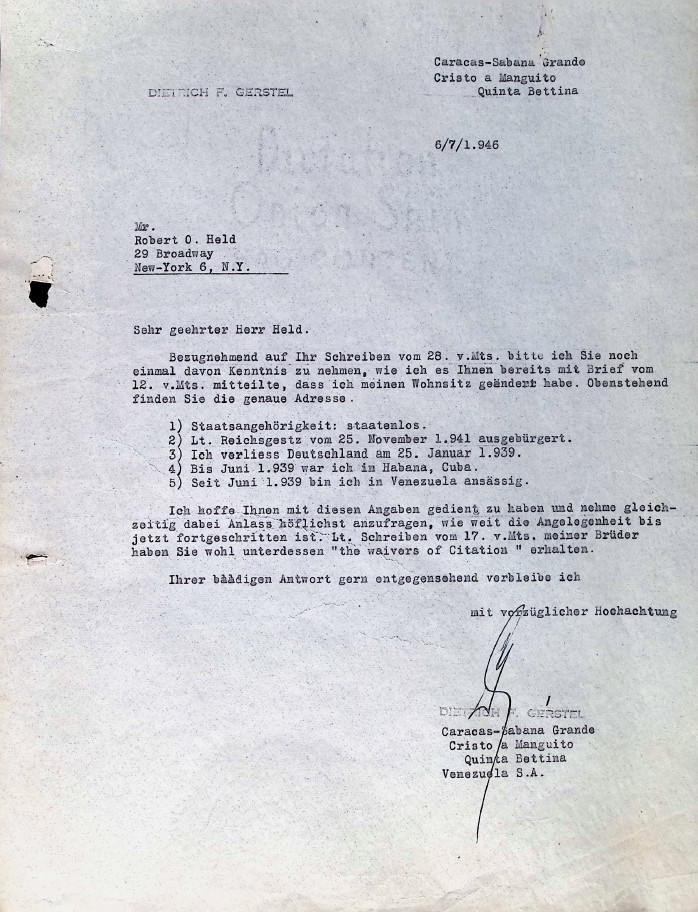
Addressed to his legal representative in New York, the statement details the loss of his German citizenship in 1941 due to Reich laws and outlines his migration route to Venezuela.
Official Gazette of the United States of Venezuela No. 22,075 (1946)
The official roster lists Dietrich Fritz Gerstel Dannenbaum and his brother-in-law Richard Ostberg, thereby legalizing their status as non-hostile aliens. National Library of Venezuela.
The Venezuelan injunction paved the way for their legal reinstatement. On March 24, 1952, the government issued Dietrich and his wife an emergency passport that served as a safe-conduct; a vital measure that provided them, for the first time in years, with a temporary legal identity. Months later, on November 12, the Legation of the Federal Republic of Germany in Caracas issued their provisional German passports, an intermediate step subject to rigorous postwar verification.
This long legal transition came to an end on February 12, 1953, with the formal restoration of his German citizenship. This act of justice was made possible by Article 116 of the Basic Law of 1949, the constitutional framework through which the new Federal Republic of Germany sought to redress—at least in the legal sphere—the deprivations and abuses committed by the Nazi regime against citizens persecuted on political or racial grounds.
Emergency passport No. 6037 issued by the United States of Venezuela in the name of Dietrich Fritz Gerstel Dannenbaum (1952)
The document, issued under Article 12 of the regulations due to the holder’s status as a stateless person, served as a temporary travel permit that explicitly identified the holder as “Not Venezuelan.”
Passport of the Federal Republic of Germany issued in Caracas in the name of Dietrich Fritz Gerstel (1952)
The document records its original date of arrival in the country via the port of La Guaira on June 28, 1939, prior to the outbreak of World War II.
The definitive milestone came on March 19, 1954, when the Official Gazette of Venezuela published the presidential decree granting Venezuelan citizenship to Dietrich and Irmgard. After fifteen years of residence in the country, this administrative act definitively brought an end to their long status as stateless persons and refugees. Venezuela was no longer merely a place of refuge but had become their official homeland—a momentous step that allowed them to put down roots and plan for their family’s future with complete legal certainty and full rights.
Decree Granting Naturalization to Dietrich Fritz Gerstel Dannenbaum and Irmgard Ostberg de Gerstel, published in the Official Gazette of Venezuela, No. 406, Special Edition (1954).
Decrees No. 45 and No. 46, granting Venezuelan citizenship to Dietrich and his wife, respectively, are published on page 13.
The Reputation of the Dietrich F. Gerstel Law Firm
During the 1950s, Dietrich F. Gerstel’s accounting firm reached the height of its professional success. It established itself as the leading German-speaking organization in Venezuela in the fields of auditing, tax consulting, and finance, becoming an indispensable institution for the German and European communities living in Caracas.
Dietrich, respectfully dubbed by the trade press as the “altmeister” (old master) of commercial law, built a reputation grounded in absolute meticulousness and unwavering ethics. His law firm, equipped with the most advanced technology of the time, offered comprehensive, high-quality services, ranging from complex financial audits to the incorporation and legal structuring of new companies.
Contemporary accounts and interviews published in local newspapers—such as the German-language daily Caracas Anzeiger— attest to his remarkable status. These accounts describe a man who, despite any physical limitations, ran his corporation with iron discipline and a forward-thinking managerial vision. His leadership was not limited to the private sector: Dietrich maintained a close and personal relationship with the community through his acclaimed column “Commerce and Industry,” a series of opinion pieces and economic analyses published regularly in the capital’s German-language weekly.
Press interview with Dietrich F. Gerstel in the Caracas Anzeiger newspaper (1958)
The article traces the growth of the Dietrich F. Gerstel Office, from its beginnings at Quinta Bettina in 1949 to its establishment at the Residencia Libertador in Caracas.
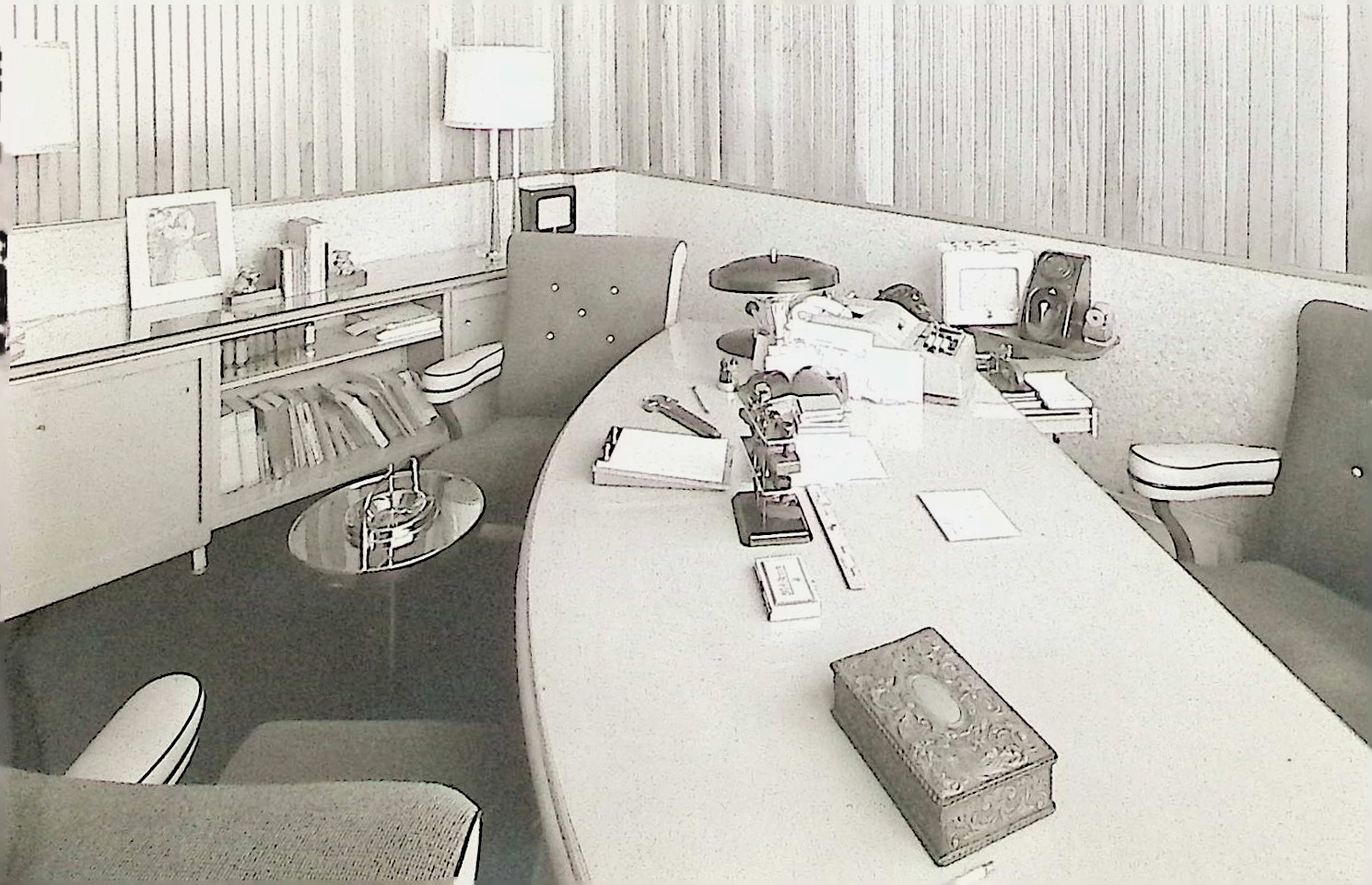

View of the Accounting Office at the Libertador Residence, Caracas, c. 1958.
Historical Documents
Certificates of Authenticity for Oriental Rugs
Documents issued by Galleries International (Abbie Vischschoonmaker) guaranteeing the authenticity of the “Fine Kashan” and “Part Silk Qum” rugs acquired by the Gerstels. These pieces attest to the aesthetic refinement and the passion for collecting that Dietrich cultivated in his Prados del Este home during his years of financial maturity.
Press Clipping: The Order of Merit for Work
An excerpt from the newspaper El Nacional documenting the bestowal of the “Order of Merit for Work,” First Class, upon Dietrich F. Gerstel by the Minister of Labor. The article publicly recognizes his “long-standing trajectory in the world of information technology and exact sciences,” as well as his work in stock market-related activities, enshrining his successful integration into Venezuelan society.
Letter Regarding the Liquidation of Securities in Germany
Correspondence sent by Eva Weill from Munich to Dietrich, confirming the sale of securities and the transfer of funds (approx. $16,000) to Caracas. This financial move coincides with the passing of his brother-in-law Richard Ostberg (which occurred that same month) and the management of family assets during a year defined by mourning.
Retrospective Cardiovascular Report
A medical report issued by Dr. Moisés Sukerman at the Centro Médico de Caracas. Although dated in the 90s, this document serves as the historical source detailing his 1970 heart attack and 1979 angina, while confirming the aortocoronary bypass surgery performed in 1980 in Houston by the renowned Dr. Denton Cooley—validating the narrative of his health struggles.
Modernization Under Marcos Pérez Jiménez (1952–1958)
A period of severe political repression that stood in stark contrast to a massive urban transformation driven by the “New National Ideal.” Caracas became a modern metropolis with highways, cable cars, and iconic hotels (such as the Waldorf or the Humboldt), making it the ideal setting for the economic growth of the Gerstel Office.
The German Economic Miracle (Wirtschaftswunder)
West Germany’s rapid postwar recovery revitalized international trade. This boom directly benefited Dietrich, who became a key accounting, commercial, and cultural bridge for German companies seeking to invest in oil-rich, prosperous Venezuela.
Democracy and the Puntofijo Pact (1958)
Following the fall of the dictatorship, a formal democratic system was established in Venezuela. Despite initial institutional turmoil, the new model fostered the consolidation of a robust and dynamic middle class—a social and professional fabric into which the Gerstel family fully integrated and belonged.
Emergency Passport for Foreigners
A travel document issued by the Ministry of Internal Affairs for refugees and German Jews who became stateless after the war. This safe-conduct pass allowed them to resume international travel for business and family reunification before obtaining permanent citizenship.
Mass Naturalizations (1954)
As part of the government’s regularization program, thousands of European immigrants were granted Venezuelan citizenship as part of a state policy aimed at legal and labor integration.
The Rise of Professional Firms
This was a period when the corporate boom spurred the formalization of auditing and tax compliance as the Income Tax Law came into full effect. Business growth demanded accounting practices in line with international standards, which culminated in the founding of the Venezuelan Association of Certified Public Accountants in July 1958.
Contexto Histórico
Primera Guerra Mundial (1914-1918)
Dietrich nació durante el último año de la guerra, en una Alemania devastada por el conflicto y marcada por la escasez alimentaria.
República de Weimar (1919-1933)
Período democrático en Alemania caracterizado por efervescencia cultural, inestabilidad política y avances médicos significativos, como los del Oskar-Helene-Heim.
Crisis de 1923
Hiperinflación catastrófica en Alemania. Un pan llegó a costar 200 mil millones de marcos. La clase media perdió sus ahorros.
30 de enero de 1933
Adolf Hitler asume como Canciller de Alemania, marcando el fin de la democracia. En marzo se aprueban las primeras leyes antisemitas.
Ley de Restauración del Funcionariado (abril 1933)
Primera ley que expulsó a judíos de cargos públicos y profesiones liberales. Afectó directamente a Walter Gerstel en sus posiciones directivas.
1934: Año de consolidación nazi
Hitler elimina oposición interna y se proclama Führer. Miles de judíos alemanes comienzan a emigrar, aunque muchos aún confían en que “pasará”.
Datos Clave
Población judía en Alemania (1933)
~500,000 personas (0.75% del total)
Judíos en Berlín
~160,000, la comunidad judía más grande de Alemania
Tasa de suicidios judíos (1933-1945)
Aumentó más del 500%
Focomelia
Ocurre en 1 de cada 100,000 nacimientos
Oskar-Helene-Heim
Fundado en 1905, pionero en ortopedia pediátrica