03
1939–1940
The Rebirth in the Tropics: From Cuba to Venezuela
Dietrich and Irmgard Gerstel’s temporary refuge in Havana, the birth of their first child, and the establishment of a business to make ends meet. A year marked by a failed attempt to emigrate to the United States and the complex logistical challenges of traveling to their final destination: Venezuela.
Cuban Exile: Traces of the Past and New Beginnings
On February 14, 1939, Dietrich and Irmgard disembarked at the port of Havana. Although they had left Nazi persecution behind, the stigma of the regime remained imprinted on their documents, as their Cuban identification papers listed them under the mandatory names “Israel” and “Sara.” In Dietrich’s case, the authorities explicitly noted his physical disability by writing “missing” in the space for his left fingerprint.
On medical advice, the couple settled in the El Vedado neighborhood, trying to adapt to a tropical climate that was radically different from the one they had known before. Amid that uncertainty and with limited resources, life went on: on March 26, 1939, their firstborn son, Thomas Walter, was born—a “Cuban relative” who symbolized the family’s first great triumph over exile.
Certificate of Registration for Dietrich Gerstel in the Cuban Registry of Foreigners (1939)
The certificate formalizes his immigration status at age 21, recording the name imposed by the German regime.
Affidavit of Income by Dietrich Gerstel in Havana, Cuba (1939)
An administrative record that formalizes your residence in Havana and certifies the maximum annual income allowed for a foreigner registered on the island.
From Havana to La Guaira: The Bridge to a New Home
Shortly after his arrival, Dietrich recognized the urgent need for housing among immigrants in Havana. With foresight and quick action, he founded a real estate agency that, within a few months, became the second-largest on the island—a thriving business that not only kept him busy but also allowed him to master the language. However, his long-term goal was not to settle there, but to make ends meet while arranging his permanent move to a new destination.
During his stay in Cuba, Dietrich underwent an evaluation by Dr. J. A. Rubiera González, who certified his condition as “congenital agenesis of both legs and the left upper limb,” suggesting that he be transferred to the United States to access advanced prosthetics and specialized care. Although this medical report was intended to support his emigration to the United States, the plan became unfeasible. Strict U.S. immigration policies, combined with the barriers posed by her physical disability and the substantial financial resources required to guarantee her support, completely ruled out that route, cementing Venezuela as her final destination.
Medical certificate issued by Dr. J. A. González Rubiera in Havana (1939)
Dietrich Gerstel’s physical condition is described, and his transfer to North America is recommended.
The Leap to the Mainland: The Journey to Venezuela
In June 1939, thanks to financial support from his relatives and the sale of his real estate agency, Dietrich set out on his journey from Cuba to Venezuela. Behind him lay a complex logistical undertaking that had forced him to temporarily part ways with his wife and his son, who was barely three months old. He made the crossing aboard the S.S. Cuba with his brother-in-law, Hellmuth Ostberg, and, as soon as he arrived in La Guaira, he raised the necessary funds for the remaining tickets. Barely a month later, Irmgard disembarked at the port with little Thomas and her brother Richard Ostberg, thus sealing the long-awaited family reunion.
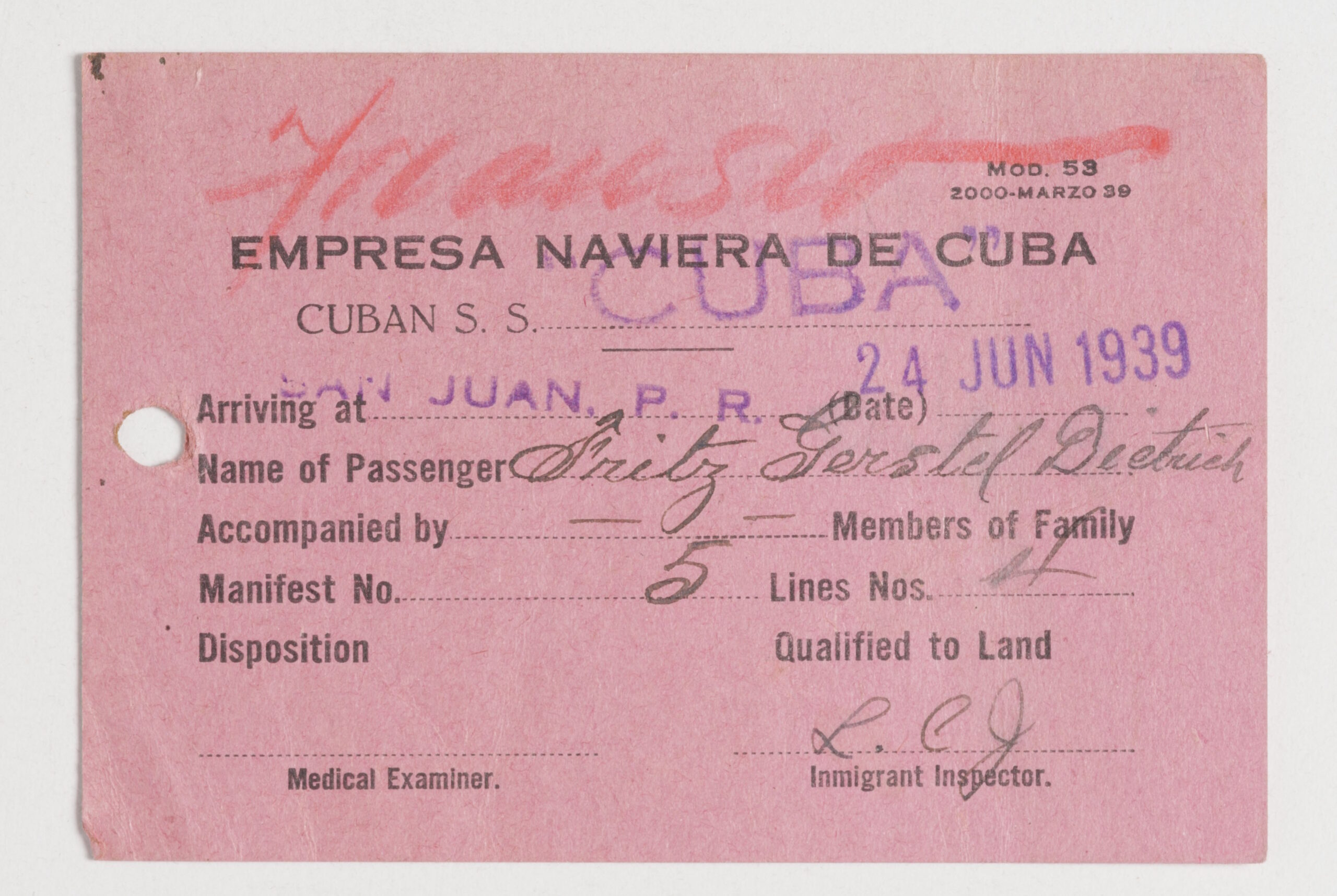
Document issued by the Cuban Shipping Company confirming his status as a passenger in transit prior to his arrival in La Guaira, Venezuela.
Tax Receipts for the Processing of Identity Cards (1939)
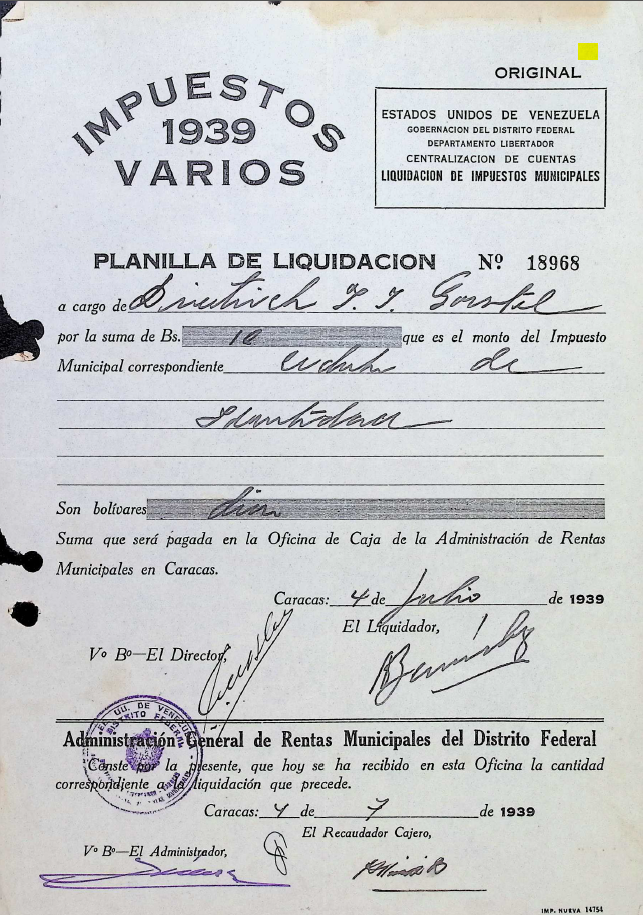
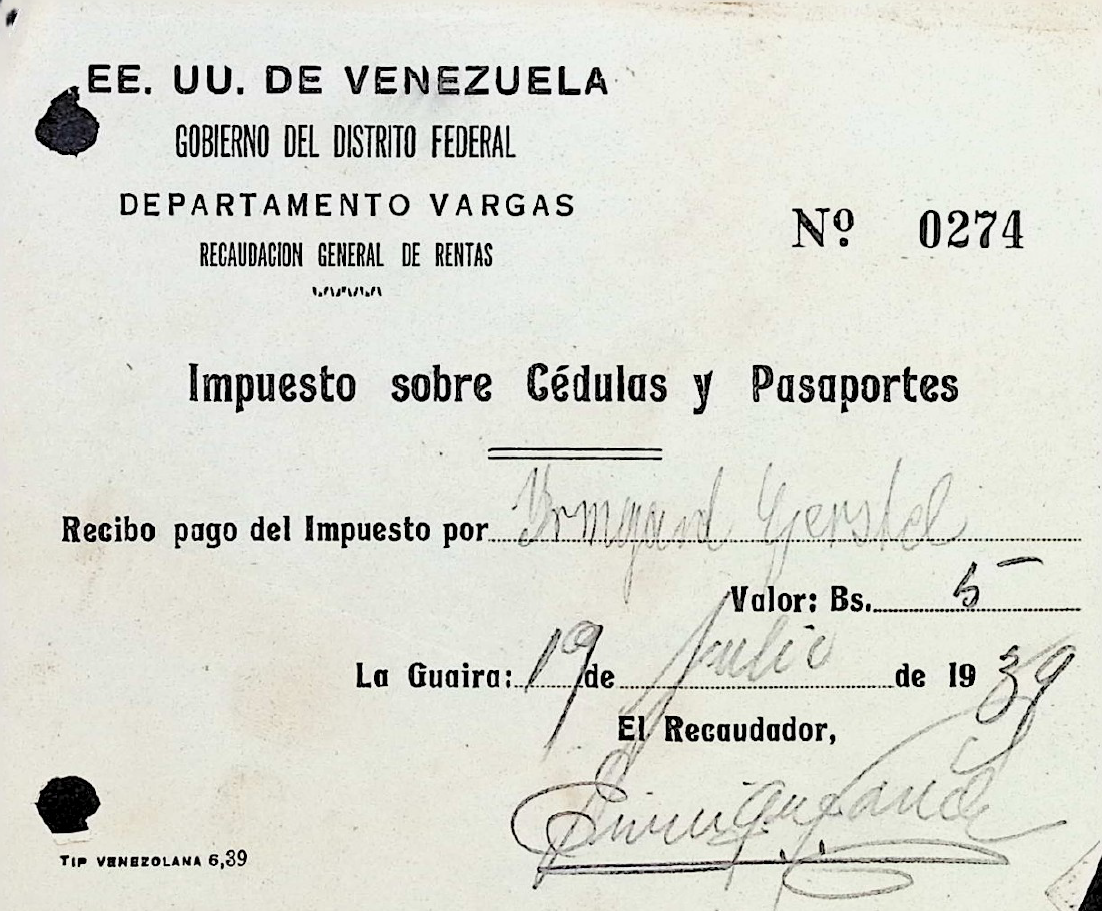
Official documents issued in Caracas and La Guaira that record the mandatory tax payments made by Dietrich and Irmgard Gerstel to formalize their legal status in the country.
Historical Documents
Affidavit of Foreign Status in Cuba
An official document filed before the Havana Registry of Foreign Nationals, where Dietrich declares his income and immigration status under the name “Fritz Israel Gerstel,” just days after his arrival on the island.
Moving Quote: Havana–Caracas
A quote from the Max Langner transport company detailing the relocation of the family’s belongings to the steamship Kuba, including “1 crib and 1 baby bathtub” for the newborn, Thomas.
Cuban Departure Tax Payment
An official receipt from the Cuban Secretariat of the Treasury for the currency export tax—an indispensable administrative step for their final emigration to Venezuela.
Job Application to the Hollandsche Bank-Unie
A letter written from his first residence in Los Jardines del Valle, Caracas, in which Dietrich offers his accounting services to the bank, highlighting his previous experience and references brought from Amsterdam.
Correspondence Regarding "Empresa Élite" (Food Business)
A letter to his cousin in New York in which Dietrich explains the closure of his electrical business and the opening of a home-delivery grocery service (“Casa Élite”), requesting suppliers for Kraft cheese and butter.
Buick Automobile Purchase Receipt
Proof of payment to the “Casa Sueca” company in Caracas for the purchase of a Buick vehicle—an essential asset for regaining his independent mobility and managing his business affairs.
Letter on the Post-War Period and the Accounting Firm
A pivotal missive to his Uncle Alfred confirming the murder of his parents-in-law in the Holocaust and announcing the sale of the food business due to exhaustion, alongside his decision to devote himself entirely to accounting and auditing.
Cuban Immigration Law and the Bond Deposit (1939)
To stem the flow of refugees, the Cuban government required a legal visa and a cash deposit of $500 per person. This extremely high financial barrier turned the process of obtaining entry permits into a lucrative market for international bureaucratic speculation.
The Maritime Bridge Between the Antilles and the Caribbean (1939–1940)
The boat trip from Havana to La Guaira was a common route for European and American transatlantic lines. This route connected the major hubs of the Caribbean and served as an escape route for thousands of passengers, coinciding with milestones such as the steamships Königstein and Caribia, which disembarked 251 Jewish refugees on the Venezuelan coast.
The Venezuelan Oil Boom (1939)
In the late 1930s, Venezuela established itself as the world’s leading oil exporter. This unprecedented macroeconomic growth led to monetary stability that was the envy of the region, attracting thousands of investors, professionals, and displaced technical workers who saw the country as a path to immediate prosperity.
World War II (1939–1945)
The global conflict broke out a few months after Dietrich’s arrival on the American continent. During the war, Venezuela became a strategic supplier of oil to the Allies, which led to wartime tensions in the Caribbean due to German submarine raids.
Refugees on the MS St. Louis (1939)
Of the 937 Jewish passengers aboard this cruise ship seeking refuge, 254 died in the Holocaust after being turned away from the United States and sent back to Europe.
The Venezuelan Economy (1940s)
The exchange rate stabilized at 3.35 bolivars per dollar. Because it was an extremely strong and backed currency, it facilitated the importation of goods and helped new immigrants integrate into the economy.
The Migration Paradox in Venezuela (1939–1941)
Despite Venezuela’s restrictive laws limiting the entry of Jewish citizens, President López Contreras demonstrated great humanitarian openness in 1939 by welcoming refugees from the ships Caribia and Königstein, who had been turned away throughout the Caribbean. In this complex legal environment, Dietrich’s successful entry and settlement stands out as a truly exceptional achievement.
Contexto Histórico
Primera Guerra Mundial (1914-1918)
Dietrich nació durante el último año de la guerra, en una Alemania devastada por el conflicto y marcada por la escasez alimentaria.
República de Weimar (1919-1933)
Período democrático en Alemania caracterizado por efervescencia cultural, inestabilidad política y avances médicos significativos, como los del Oskar-Helene-Heim.
Crisis de 1923
Hiperinflación catastrófica en Alemania. Un pan llegó a costar 200 mil millones de marcos. La clase media perdió sus ahorros.
30 de enero de 1933
Adolf Hitler asume como Canciller de Alemania, marcando el fin de la democracia. En marzo se aprueban las primeras leyes antisemitas.
Ley de Restauración del Funcionariado (abril 1933)
Primera ley que expulsó a judíos de cargos públicos y profesiones liberales. Afectó directamente a Walter Gerstel en sus posiciones directivas.
1934: Año de consolidación nazi
Hitler elimina oposición interna y se proclama Führer. Miles de judíos alemanes comienzan a emigrar, aunque muchos aún confían en que “pasará”.
Datos Clave
Población judía en Alemania (1933)
~500,000 personas (0.75% del total)
Judíos en Berlín
~160,000, la comunidad judía más grande de Alemania
Tasa de suicidios judíos (1933-1945)
Aumentó más del 500%
Focomelia
Ocurre en 1 de cada 100,000 nacimientos
Oskar-Helene-Heim
Fundado en 1905, pionero en ortopedia pediátrica