02
1935 - 1939
Resistance, Love, and the Road to Exile
Dietrich Gerstel’s transition to adulthood in a Germany marked by Nazi radicalization. His struggle with the stifling professional difficulties caused by segregation and his marriage to Irmgard Ostberg, which paved the way for a frantic bureaucratic race to escape the country before the outbreak of World War II.
Rejection Letters: A Jew's Job Search
Upon completing his education, Dietrich embarked on an arduous job search throughout 1936. In search of employment, he sent numerous letters to companies, banks, and key contacts, such as the banker Otto Jeidels—a partner at the Berliner Handels-Gesellschaft—and Karl Morawe, director of Permutit AG. Although figures such as Jewish community activist Lola Hahn-Warburg tried to support him by forwarding his application to aid organizations, the responses from the job market were unanimously negative—a systematic blockade that proved impervious to even the recommendations and reputation of his late father.
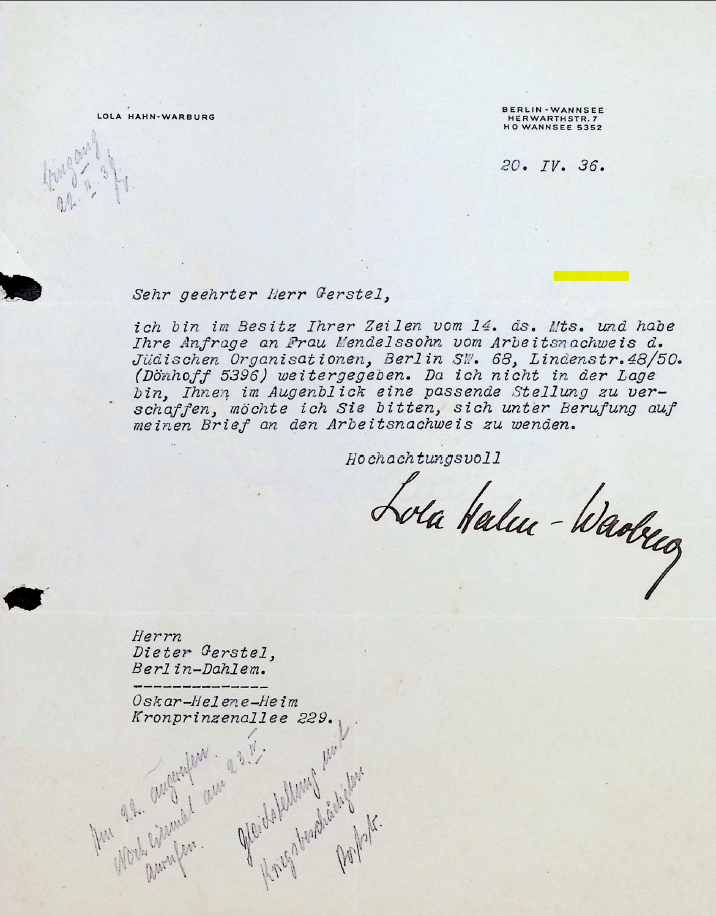
Given the lack of direct job openings, the community leader reports that she has forwarded Dietrich’s job application to the job board for Jewish organizations in Berlin.
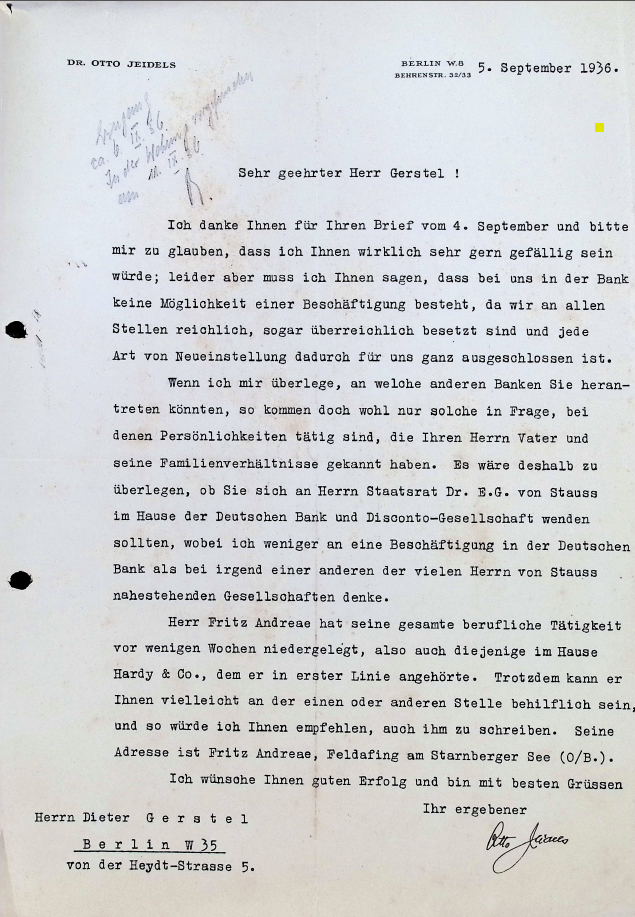
Jeidels rejects the job application due to the bank’s hiring freeze. The document confirms that the banking sector is permanently closed to the Jewish community.
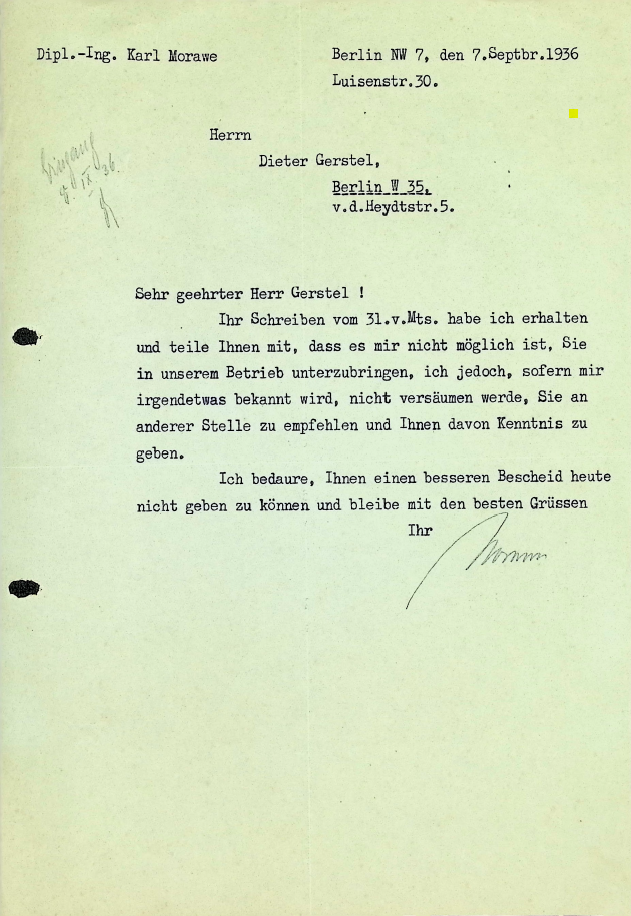
Morawe turns down the request, although he offers to recommend Dietrich if an external opening becomes available.
Dietrich at Kosmos Neuheiten: Hostility and Dignity in the Workplace
Finally, in April 1937, Dietrich managed to get a job at the export firm Kosmos Neuheiten G.m.b.H. in Berlin. Although he started as a volunteer with a nominal stipend of 50 German marks (RM), his performance soon earned him a permanent position with a salary of 100 RM. There, he took on accounting and cashier duties, demonstrating a level of competence that his own employers acknowledged in writing.
However, the working relationship broke down dramatically in March 1938. Faced with her impending marriage and rising expenses, Dietrich requested a pay raise. Management’s response, signed by Ernst Neuberg, was humiliating: it characterized her employment as an “act of charity” and denied the raise.
Far from accepting the deal, Dietrich resigned with dignity on March 31, 1938, thus bringing his last formal employment in Nazi Germany to a close.
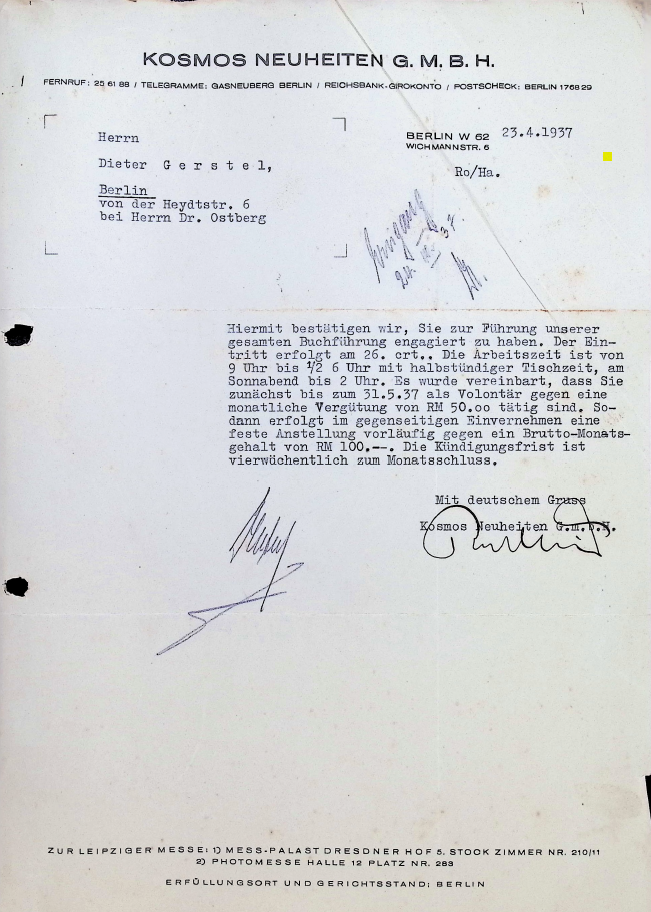
The document formalizes his hiring to take charge of the company’s entire accounting.
Letter from Ernst Neuberg to Dietrich Gerstel (1938).
After calling it “charity,” she asks him to resign before his upcoming wedding.
Love and Resistance: Unity in Times of Persecution
On a personal level, Dietrich maintained a steady romantic correspondence with Rosemarie Albers, a nurse at the Oskar-Helene-Heim (OHH), throughout 1934. However, distance and the passage of time cooled their bond, until the relationship eventually fizzled out. Around 1936, while living as a boarder in the Ostberg family’s home, he met Irmgard, the daughter of attorney Ernst Ostberg. Their romance deepened through an intense exchange of letters during the summer of that same year and was formalized with their engagement in November 1937.
Finally, on April 14, 1938, Dietrich Gerstel and Irmgard Ostberg were married at the Berlin-Tiergarten Civil Registry Office. The couple took up residence at 6 Von-der-Heydt-Straße. Against a backdrop of growing hostility and persecution, this union was not merely a family decision; it represented an act of resistance and a firm affirmation of life and the future.
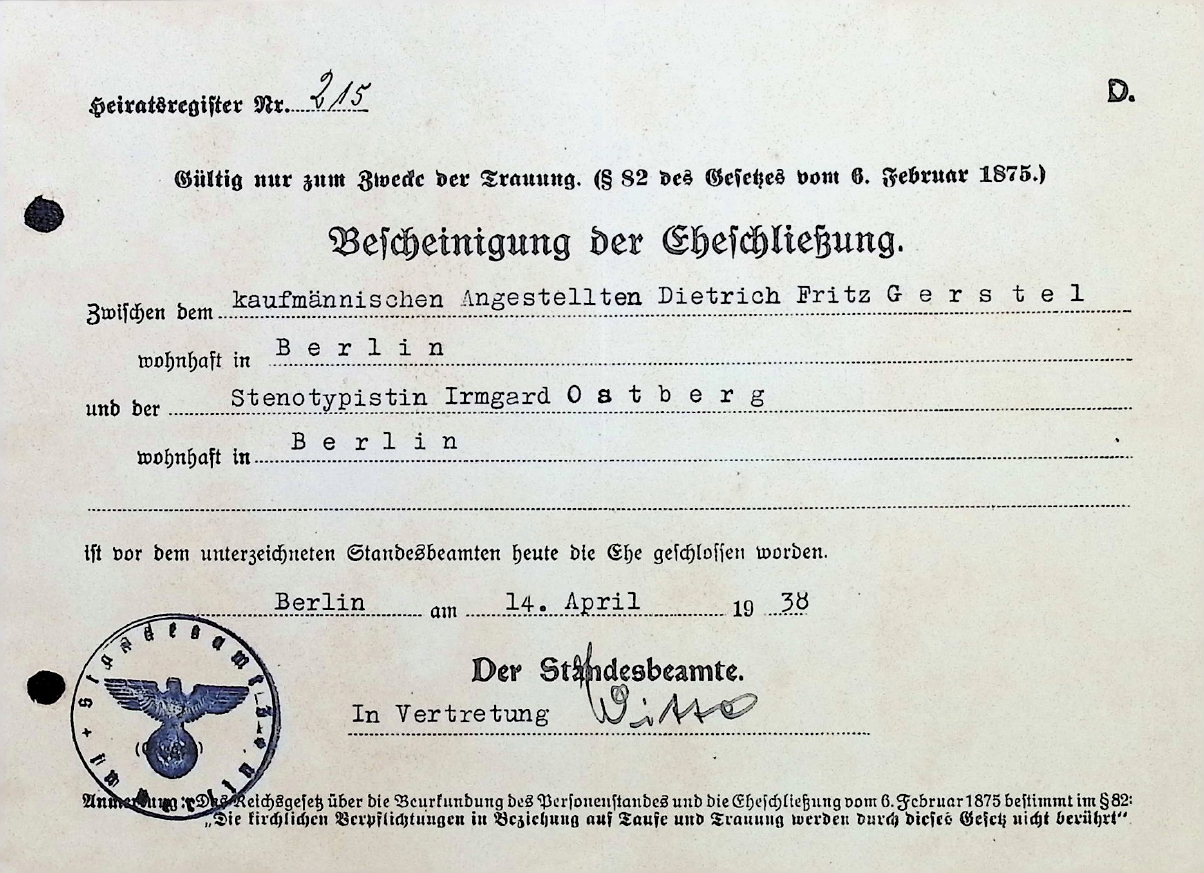
The official document, issued under registration No. 215 in Berlin, formalizes the couple’s civil union. The certificate identifies Dietrich as a sales clerk and Irmgard as a stenographer.
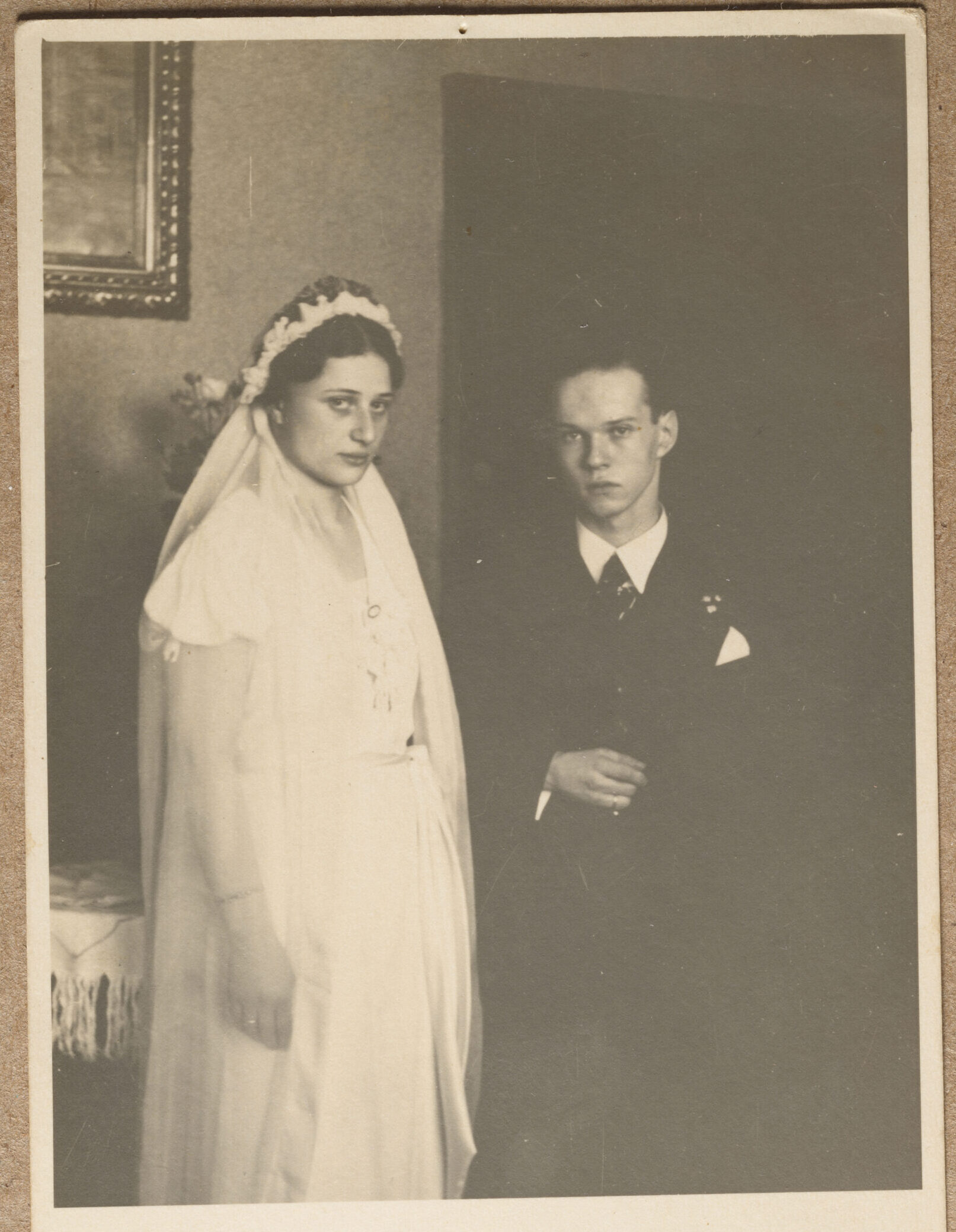
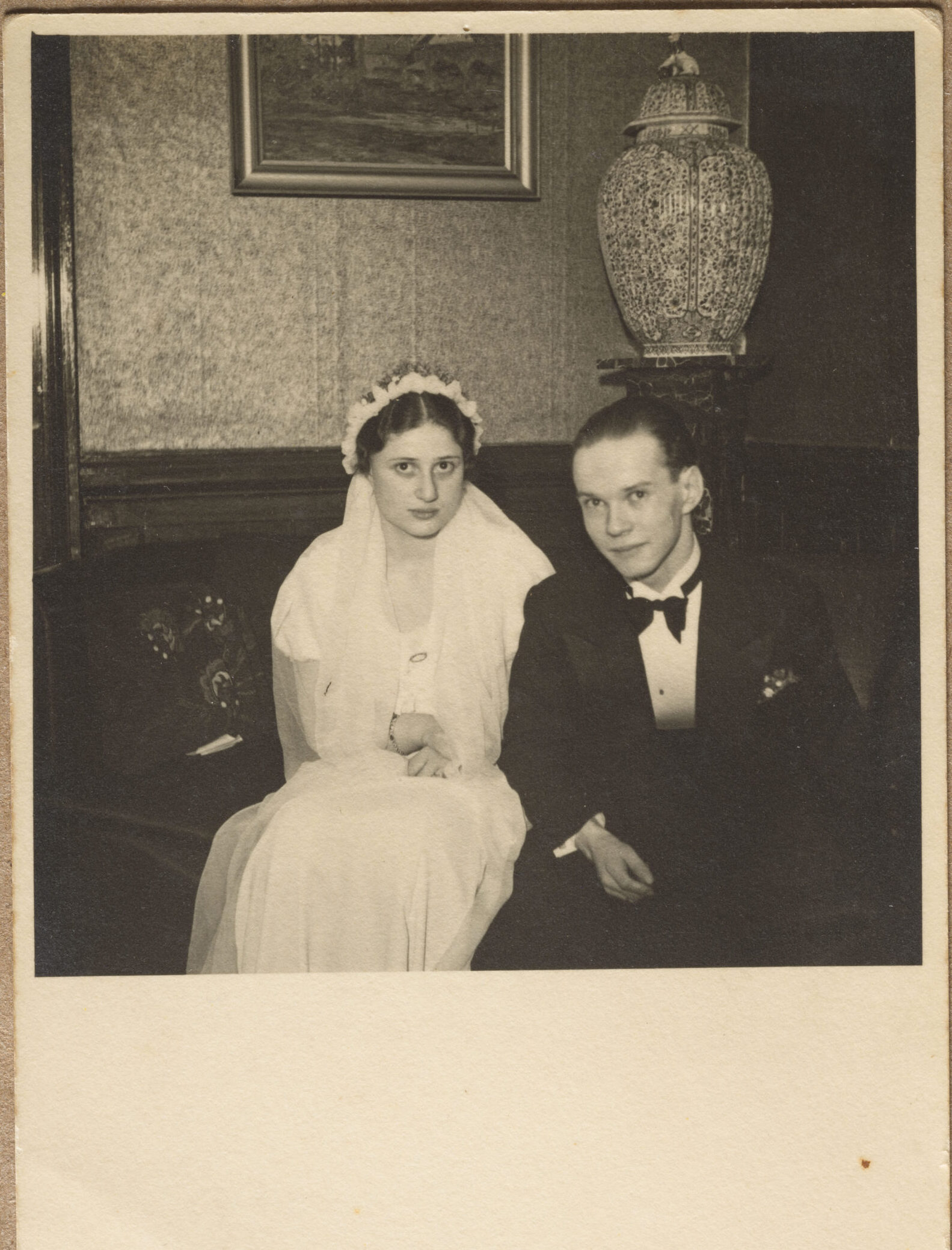
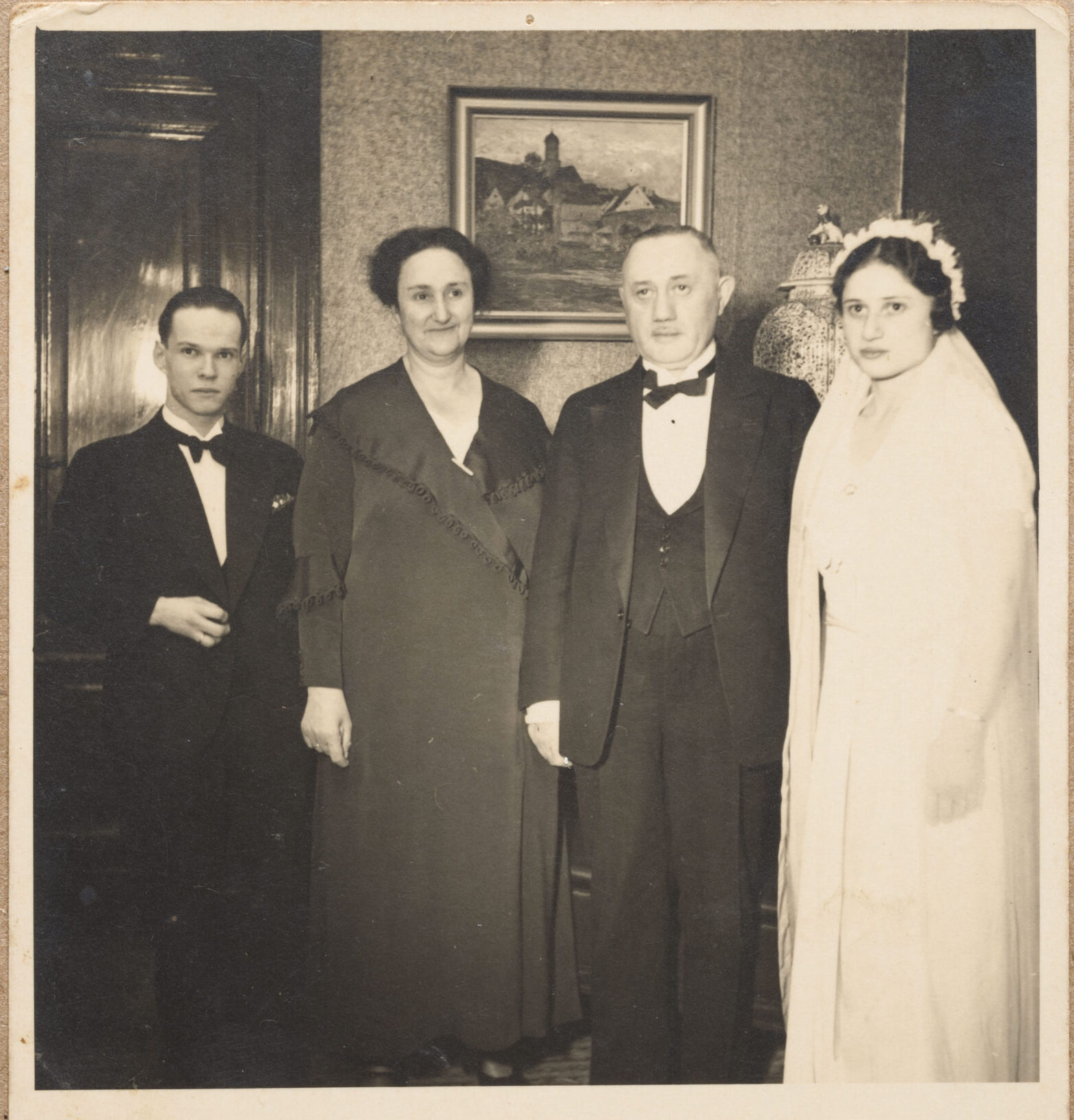
Dietrich and Irmgard Gerstel (née Ostberg) at their civil wedding, accompanied by the bride’s parents, Ernst and Elsa Ostberg. Berlin, Germany. April 14, 1988.
Marked by the Regime: Bureaucracy, Control, and Dispossession
The pressure exerted by the Nazi regime on Dietrich’s life intensified dramatically beginning in 1937. In April of that year, the Berlin police summoned him to open his military file; three months later, he was issued his Military Service Book (Wehrpass). In that document, Dietrich was classified as part of the “Replacement Reserve II” (Ersatzreserve II), a category assigned solely on the basis of his ancestry. Far from being a routine formality, this classification functioned as a perverse mechanism of administrative segregation and systematic exclusion within the regime.
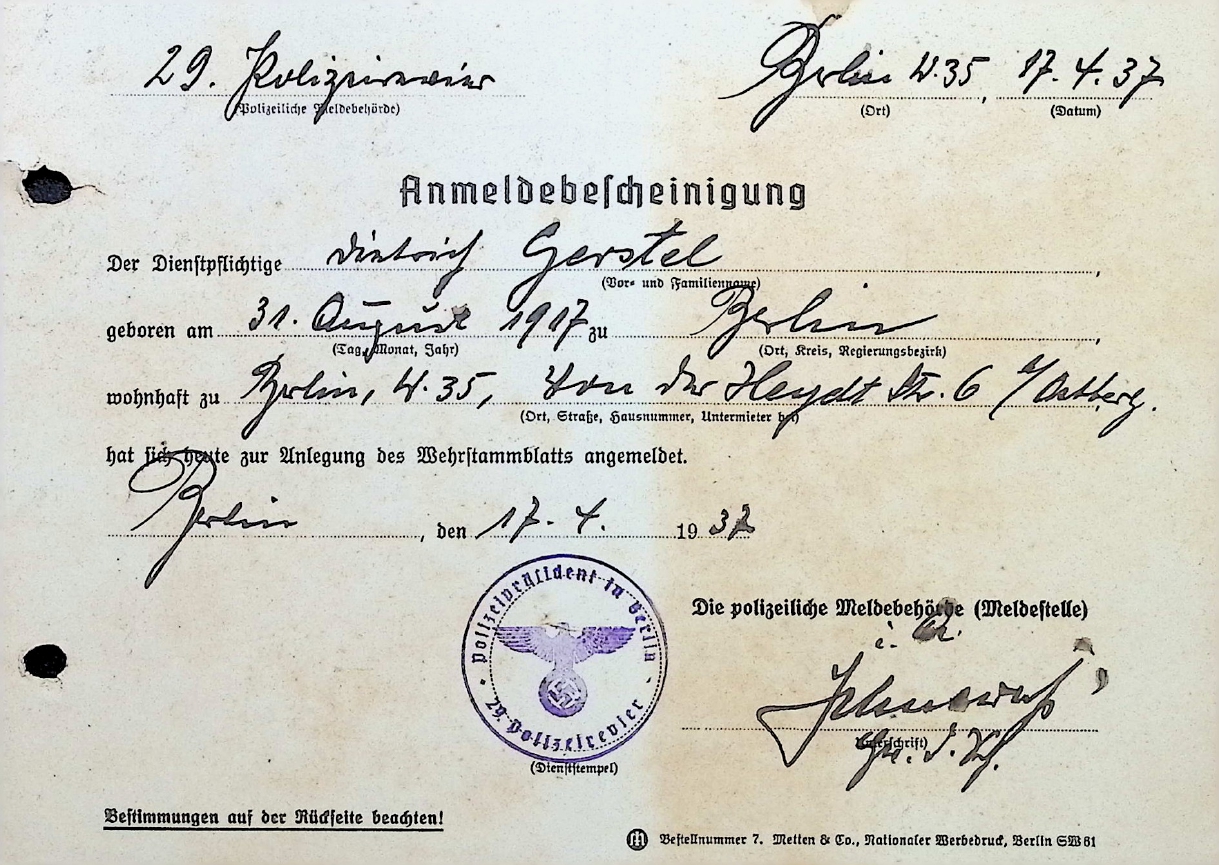
Document issued by Berlin’s 29th Police District formalizing his registration for mandatory military service.
Dietrich Gerstel's Military Service Record (1937)
The document details his official photograph, personal information, and his assignment to the Replacement Reserve Category II, reflecting the bureaucratic oversight prior to his emigration.
By the end of 1938, the persecution had become suffocating. Following the violence of the November Pogrom and the enactment of the decree for the definitive elimination of Jews from German economic life in November of that year, the situation became untenable. Against this backdrop, Dietrich was forced to:
- The imposition of registered names: Requesting that the name “Israel” be added to her identity, while Irmgard was required to add the name “Sara,” in strict compliance with the Nazi law on changes to first and last names.
- The loss of mobility and independence: In December 1938, he had to surrender his driver’s license and his vehicle’s registration. This marked the end of the independent mobility he valued so highly and had managed to preserve by adapting his own car.
- Financial plunder: He suffered the confiscation of his assets and the systematic freezing of all his bank accounts.
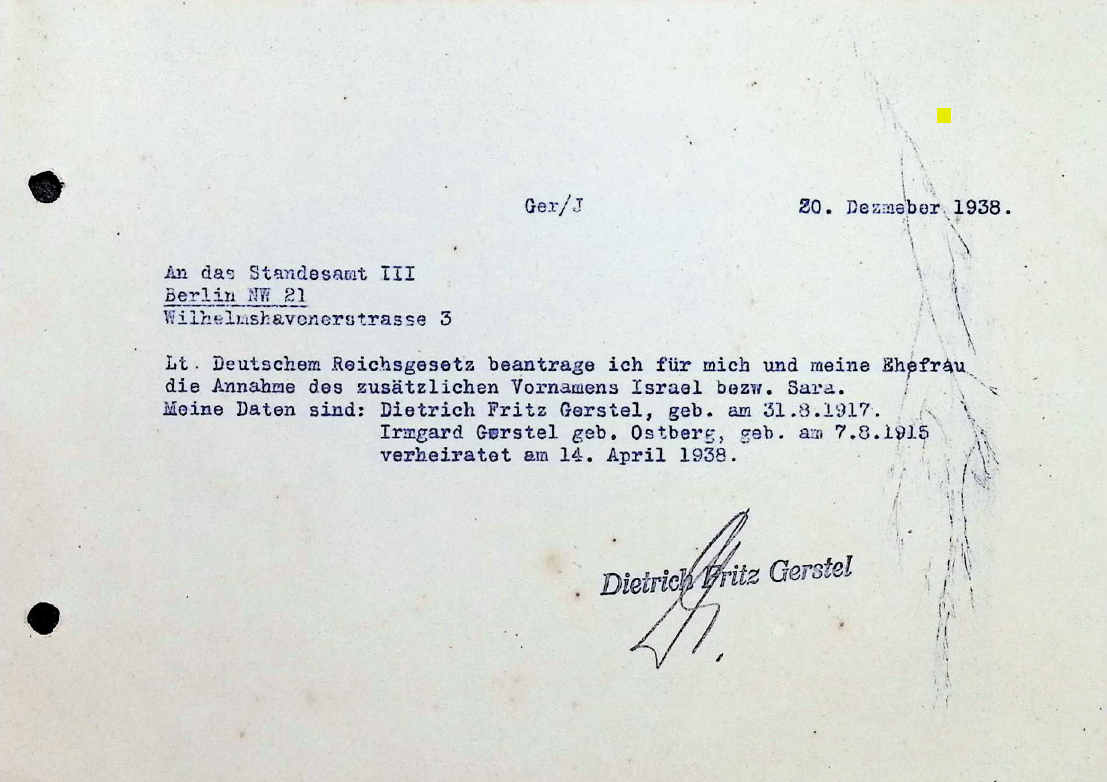
A formal document in which Dietrich Gerstel requests that the Berlin Civil Registry Office III add the names “Israel” and “Sara” to his and his wife Irmgard’s records, in accordance with the laws of the Nazi regime.
The Odyssey of Emigration: From Berlin to Havana
Faced with the impossibility of staying in Germany, the newlyweds began a frantic race against time to emigrate. Dietrich considered destinations such as the United States—an option ruled out due to restrictive U.S. immigration laws regarding people with disabilities—and Palestine, where his older siblings had already settled. Ultimately, the viable path led to Latin America.
The escape process required an overwhelming amount of documentation demanded by the regime: birth certificates for their ancestors to prove their origins, certificates of good conduct, and rigorous medical examinations to confirm their fitness for the journey. Despite suffocating financial difficulties, the family managed to book tickets with the Hamburg-Amerika Linie (HAPAG) shipping company.
The final visa arrived after months of paperwork: the Berlin Advisory Office for Emigrants issued its official certificate for travel to South America on November 22, 1938. After obtaining the necessary tax and labor clearances, the destination was finalized on January 25, 1939.
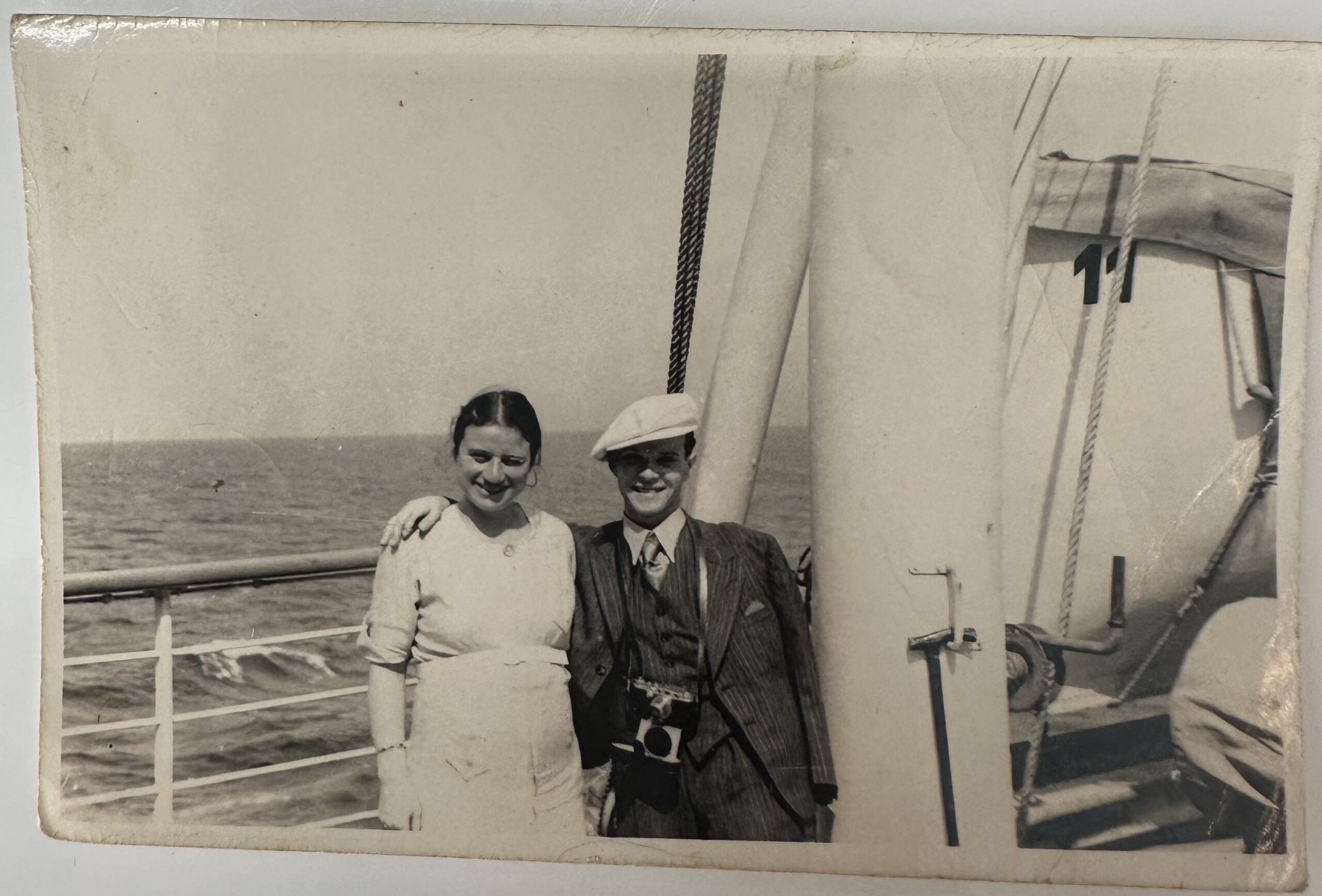
Dietrich, Irmgard, and her brother-in-law, Hellmuth Ostberg, boarded the steamship M.S. Orinoco. As they set sail from the port of Hamburg, they left behind their property, their citizenship, and the life they knew, setting course for an uncertain future with Havana, Cuba, as their first destination.
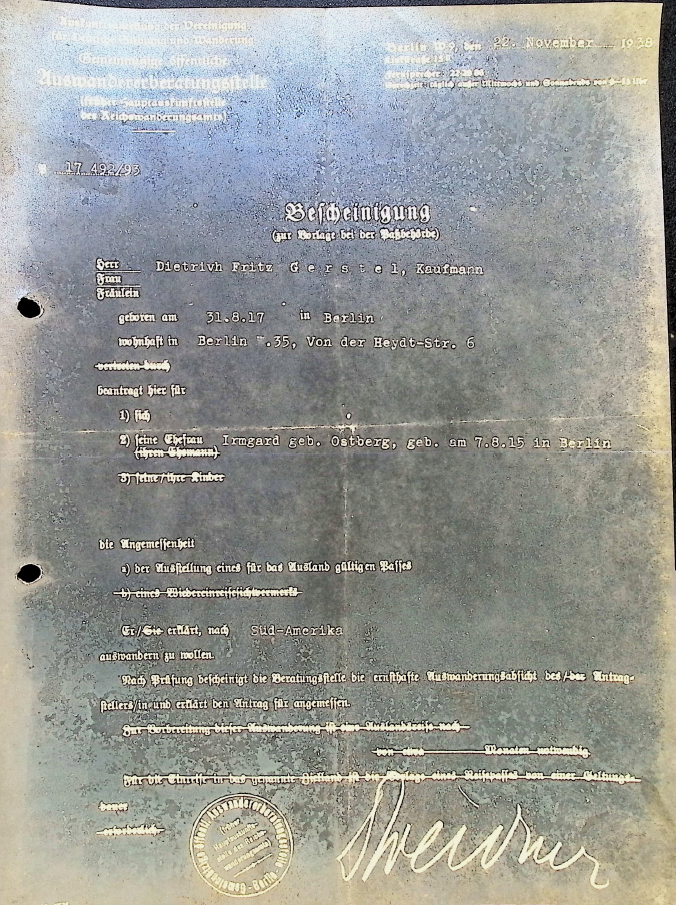
The document confirms Dietrich Gerstel and Irmgard Ostberg’s intention to emigrate to South America.
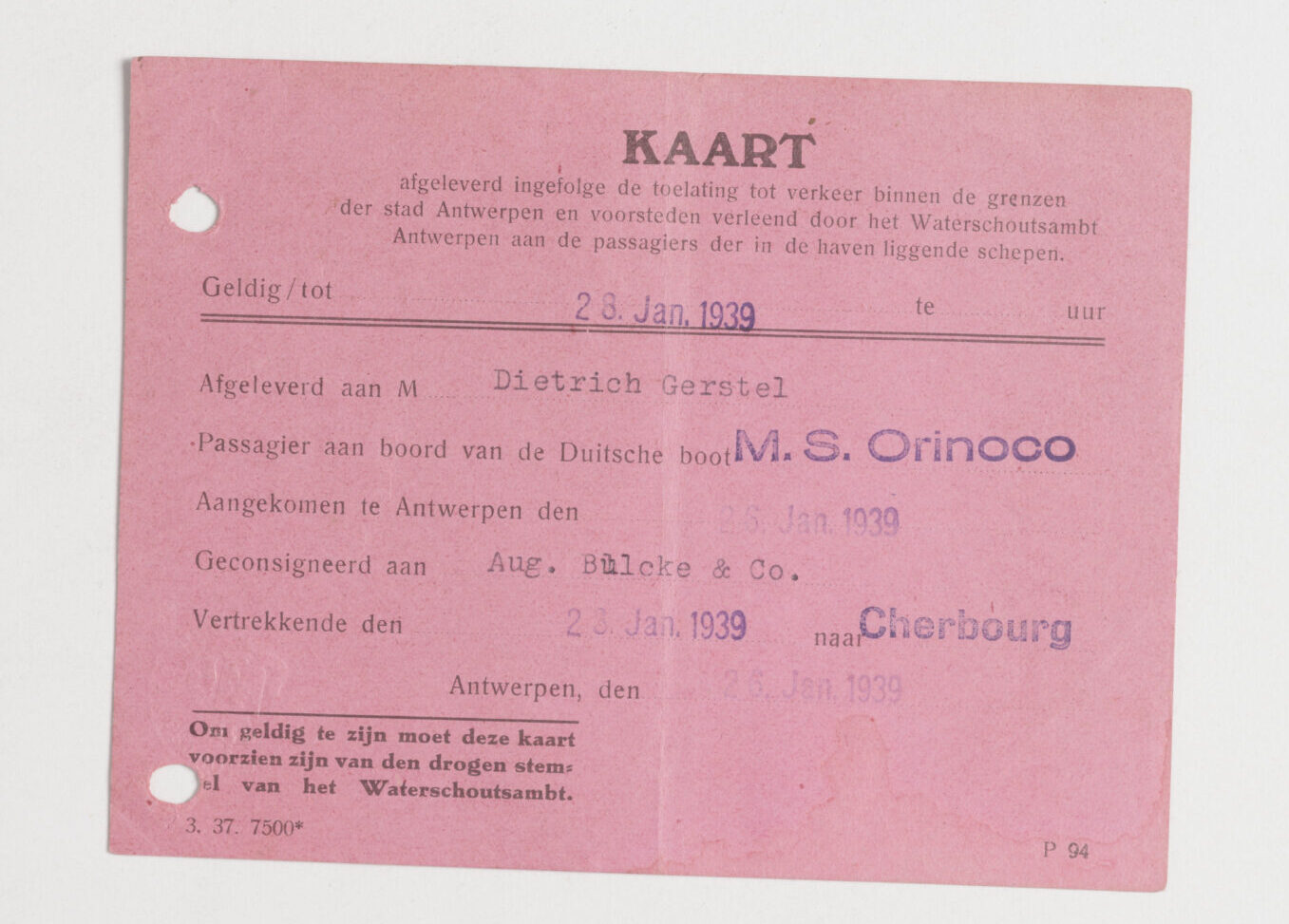
The permit authorized the passenger to move about the city during the ship’s stopover, prior to its departure for Cherbourg, France.
Historical Documents
Provisional Certificate, O.H.H.
Record of skills acquired during commercial apprenticeship. Documents Dietrich’s competence in accounting and typing.
Reference Letter, O.H.H.
Final document praising his “great energy” in overcoming disability. Marks the end of his training before being forced to withdraw for being “non-Aryan.”
Employment Rejection
Letter from Otto Jeidels rejecting his application. Evidence of the systematic barriers in the labor market for Jews in 1936.
Employment Confirmation at Kosmos
Contract with Kosmos Neuheiten G.m.b.H. His only formal employment after apprenticeship, initially as a volunteer with 50 RM.
Military Registration Certificate
Classification in “Reserve II for Precaution” due to ancestry. A form of administrative segregation under the Nazi regime.
Wedding Rings Invoice
Personal document prior to marriage. Symbolizes hope and commitment amid persecution.
Salary Increase Refusal
Humiliating response from Ernst Neuberg describing his hiring as an “act of charity.” Precipitated his resignation.
Employment Termination
Final certificate from Kosmos Neuheiten. Marks the end of his formal working life in Germany.
Marriage Certificate
Official union with Irmgard Ostberg in Berlin-Tiergarten. An affirmation of life in a context of growing hostility.
Driving Ban for Jews
Decree by Heinrich Himmler eliminating driving licenses for Jews. Dietrich lost the independent mobility he had adapted to his disability.
Application for Additional Name for Jews
Forced compliance with the naming law. Dietrich added “Israel” and Irmgard “Sara” to their official identities.
Fiscal Non-Objection Certificate
Indispensable requirement certifying payment of confiscatory taxes. Without this document they could not leave Germany.
Certificate of Conduct and Criminal Record
Police certificate of good conduct required for emigration. Part of the bureaucratic labyrinth necessary to escape.
International Health Certificate
Medical document from HAPAG certifying his fitness to travel despite disability. Allowed him to board the M.S. Orinoco toward freedom.
Nuremberg Laws (1935)
They stripped the Jewish population of German citizenship and banned intermarriage, thereby establishing the legal basis for systematic persecution.
Deutsche Arbeitsfront (1933-1945)
The German Labor Front, which replaced the traditional unions and completely excluded Jewish workers from economic and business activities.
November Pogrom (November 9–10, 1938)
This violent, large-scale wave of violence resulted in the destruction of 267 synagogues, the looting of 7,500 businesses, the reported deaths of 91 people, and more than 30,000 arrests.
Name Change Act (August 1938)
A decree that required Jewish citizens to adopt the names “Israel” for men and “Sara” for women as a coercive measure of marking and identification.
Jewish Emigration (1933–1939)
About 282,000 German Jews managed to emigrate before the outbreak of the war, facing an extremely costly, bureaucratic, and depriving process.
M.S. St. Louis (May 1939)
An ocean liner carrying 937 Jewish refugees who were turned away by Cuba and the United States, becoming a global symbol of closed borders. Dietrich managed to leave Germany just a few months before this tragic episode.
Jews in Germany (1938)
There were approximately 400,000 people left in the country, since a large portion of the original population had already managed to emigrate.
Cost of Emigration
The Nazi regime confiscated between 80% and 90% of family assets through the so-called “flight tax” and foreign exchange penalties.
Arrests During the November Pogrom (1938)
Nearly 30,000 Jewish men were arrested and sent en masse to concentration camps during the pogrom.
HAPAG (Hamburg-Amerika Linie)
The leading German shipping company used as a means of transportation and escape to the Americas.
The Value of Travel (1937)
100 Reichsmarks were worth about 40 U.S. dollars (Dietrich’s monthly salary). In contrast, a ship ticket to America cost the equivalent of several months’ average salary.
Contexto Histórico
Primera Guerra Mundial (1914-1918)
Dietrich nació durante el último año de la guerra, en una Alemania devastada por el conflicto y marcada por la escasez alimentaria.
República de Weimar (1919-1933)
Período democrático en Alemania caracterizado por efervescencia cultural, inestabilidad política y avances médicos significativos, como los del Oskar-Helene-Heim.
Crisis de 1923
Hiperinflación catastrófica en Alemania. Un pan llegó a costar 200 mil millones de marcos. La clase media perdió sus ahorros.
30 de enero de 1933
Adolf Hitler asume como Canciller de Alemania, marcando el fin de la democracia. En marzo se aprueban las primeras leyes antisemitas.
Ley de Restauración del Funcionariado (abril 1933)
Primera ley que expulsó a judíos de cargos públicos y profesiones liberales. Afectó directamente a Walter Gerstel en sus posiciones directivas.
1934: Año de consolidación nazi
Hitler elimina oposición interna y se proclama Führer. Miles de judíos alemanes comienzan a emigrar, aunque muchos aún confían en que “pasará”.
Datos Clave
Población judía en Alemania (1933)
~500,000 personas (0.75% del total)
Judíos en Berlín
~160,000, la comunidad judía más grande de Alemania
Tasa de suicidios judíos (1933-1945)
Aumentó más del 500%
Focomelia
Ocurre en 1 de cada 100,000 nacimientos
Oskar-Helene-Heim
Fundado en 1905, pionero en ortopedia pediátrica