03
1939–1940
The Caribbean Stopover and a New Beginning
Dietrich’s transition into adulthood unfolded against the backdrop of Nazi radicalization. It was a period marked by the culmination of his professional training, the onset of extreme hardships in the labor market, his marriage to Irmgard Ostberg, and a frantic bureaucratic race to escape Germany before the outbreak of war.
Havana: Sanctuary and Motherhood
On February 14, 1939, Dietrich and Irmgard disembarked at the Port of Havana, leaving Nazi persecution behind but still bearing the stigma within their documents: their Cuban identification papers registered them under the mandatory names “Israel” and “Sara.” In Dietrich’s case, his physical disability was explicitly noted with the remark “missing” (falta) on his fingerprint record. They settled in the El Vedado neighborhood upon medical advice, attempting to adapt to a tropical climate that stood in stark contrast to their former lives. Amidst this backdrop of uncertainty and meager resources, their firstborn, Thomas Walter, was born on March 26, 1939—a “Cuban relative” who symbolized life’s first triumph over exile.
Affidavit of Foreign Status in Cuba
The Leap to the Mainland: Venezuela
The economic situation in Cuba and the United States’ immigration restrictions against persons with disabilities forced Dietrich to seek a new horizon. In mid-1939, he made the decision to migrate to Venezuela. It was a complex logistical operation that required temporarily splitting the family and transporting luggage that contained the sum of their entire lives: five crates, a wardrobe trunk, and even a crib. After arriving in La Guaira and later reuniting with Irmgard, they settled in the Los Jardines del Valle neighborhood in Caracas. Although the cultural shock and the language barrier were initial hurdles, Dietrich soon reclaimed his civil identity, successfully removing the name “Israel” from his papers and beginning to offer his accounting services to local banks and firms.
Entrepreneurship and Family Growth
The 1940s were a period of intense searching for stability. Dietrich ventured into various businesses, ranging from the importation of electrical materials to the founding of “Casa Élite,” an innovative food enterprise offering home delivery services. Meanwhile, the family grew on Venezuelan soil with the births of Renate, Bettina, Hans Peter, and Graciela. However, they also faced profound grief with the loss of infant Rosemarie in 1942. Bit by bit, the family began to acquire the hallmarks of a middle-class life—purchasing furniture on credit and acquiring vehicles that Dietrich himself modified for driving, thereby reclaiming the independent mobility so vital to his self-esteem and his trade.
The Echo of War and the Return to Accounting
The end of the Second World War brought confirmation of the tragedies they had long feared. Through harrowing letters, Dietrich learned of his parents-in-law’s murder in the concentration camps, and in 1946, he suffered the death of his mother in New York—severing the last physical tie to his protective past. Exhausted by the food business, he decided to return to his true vocation: around 1949, he founded the “Gerstel Office.” Operating out of Quinta Bettina, he began to build a reputation for integrity and efficiency in auditing and accounting, laying the foundations of the estate that would sustain his family for decades to come.
Dietrich to Alfred Gerstel: Post-War Aftermath (Caracas–Berkeley)
Historical Documents
Affidavit of Foreign Status in Cuba
An official document filed before the Havana Registry of Foreign Nationals, where Dietrich declares his income and immigration status under the name “Fritz Israel Gerstel,” just days after his arrival on the island.
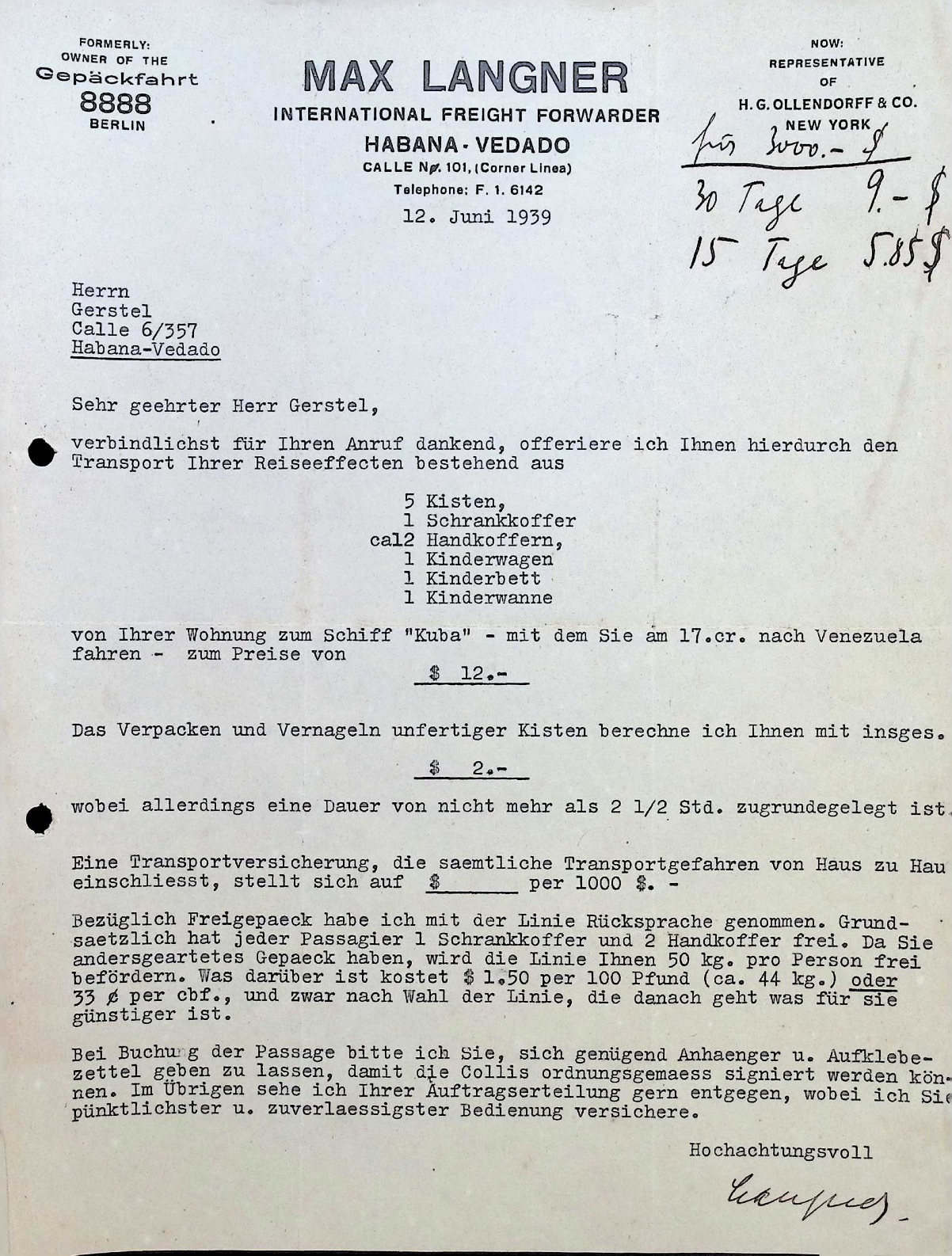
Moving Quote: Havana–Caracas
A quote from the Max Langner transport company detailing the relocation of the family’s belongings to the steamship Kuba, including “1 crib and 1 baby bathtub” for the newborn, Thomas.
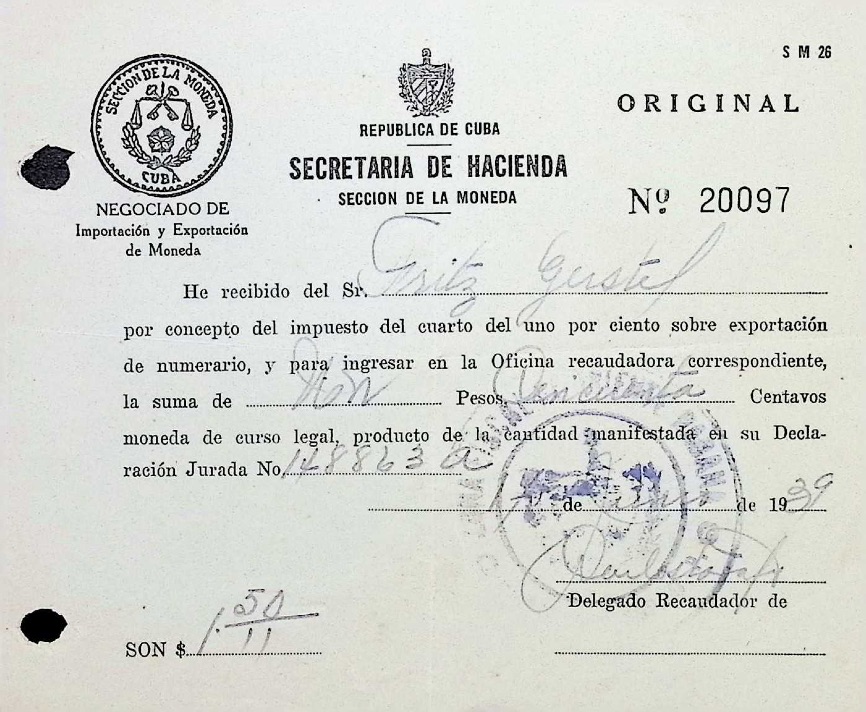
Cuban Departure Tax Payment
An official receipt from the Cuban Secretariat of the Treasury for the currency export tax—an indispensable administrative step for their final emigration to Venezuela.
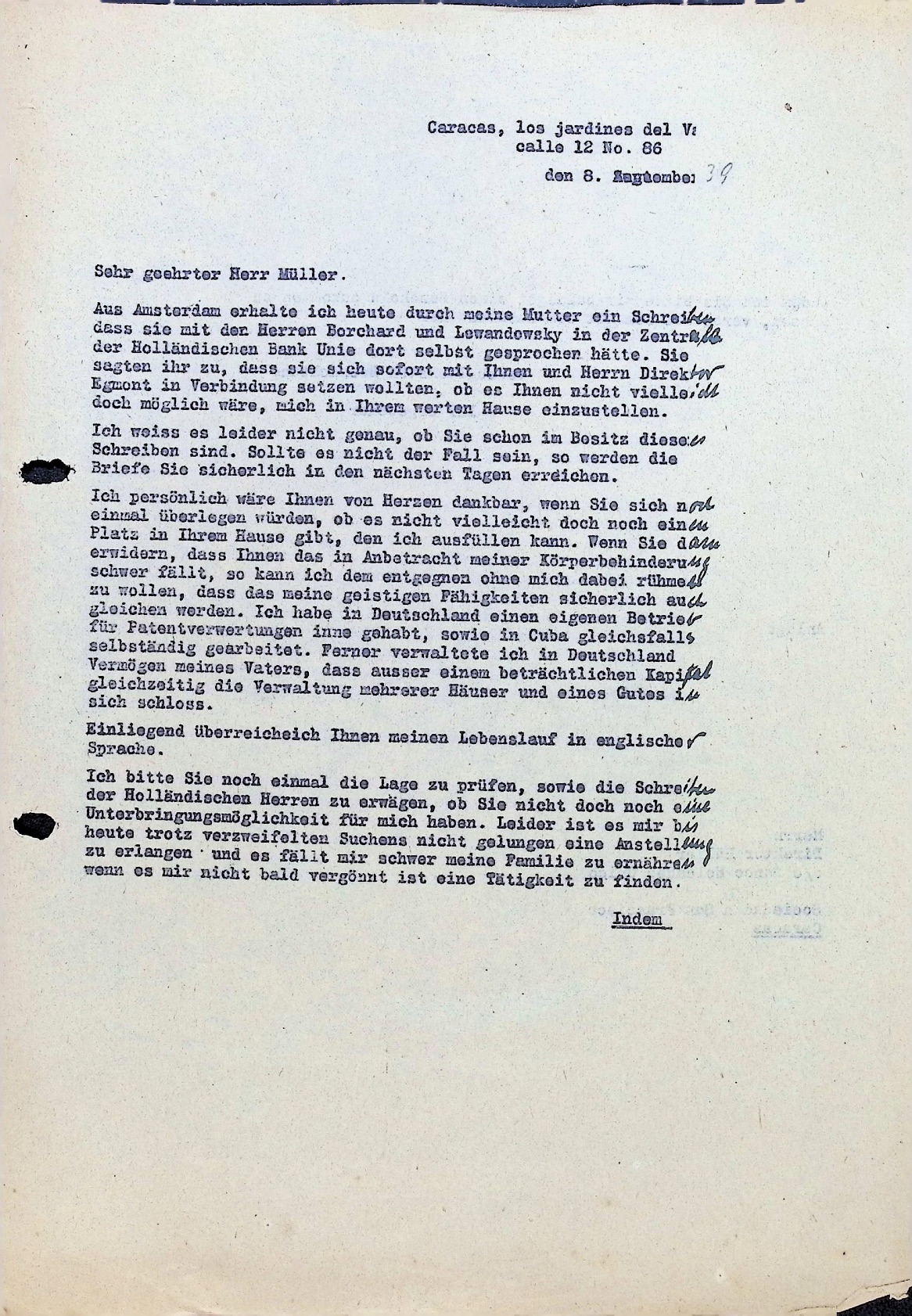
Job Application to the Hollandsche Bank-Unie
A letter written from his first residence in Los Jardines del Valle, Caracas, in which Dietrich offers his accounting services to the bank, highlighting his previous experience and references brought from Amsterdam.
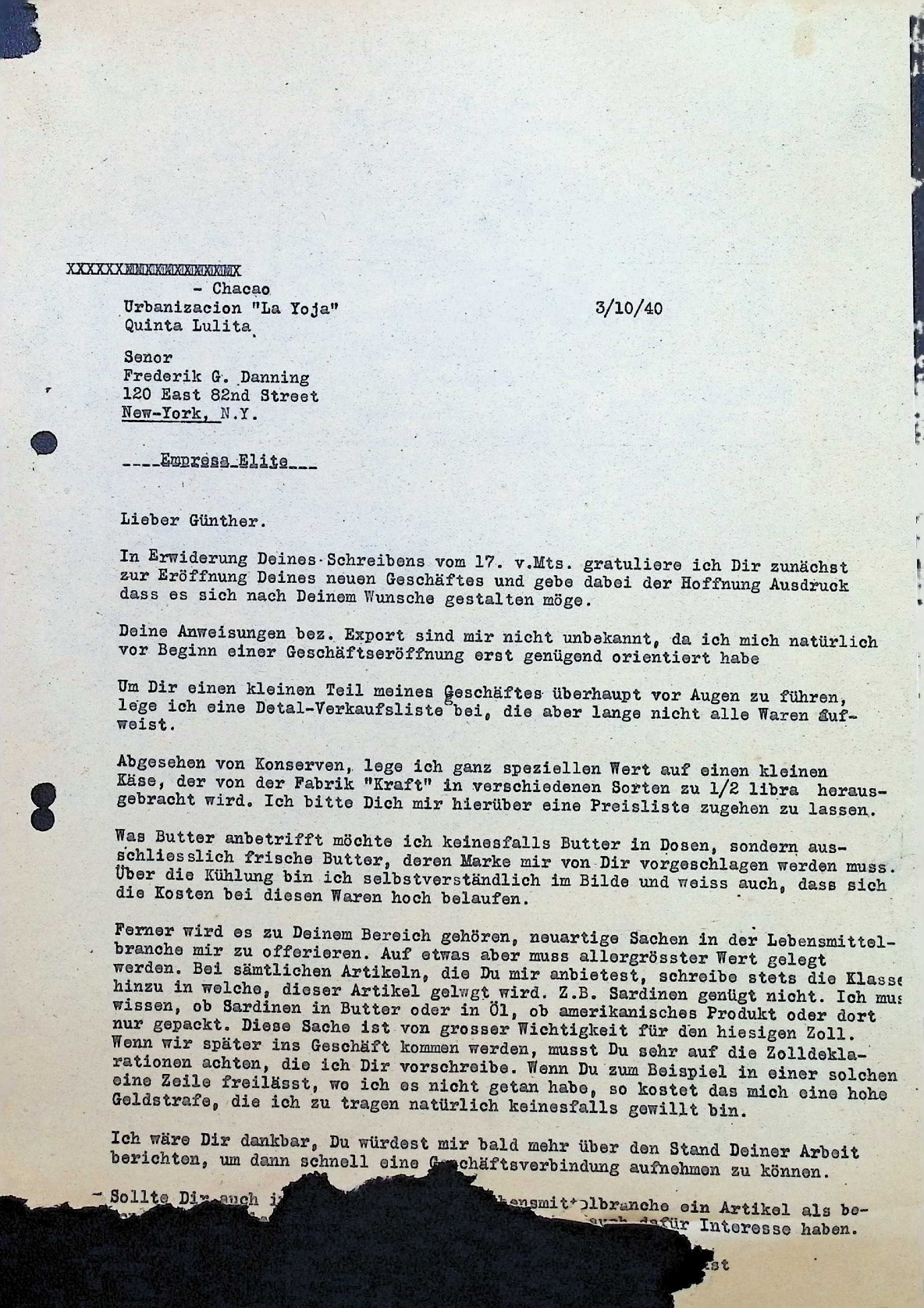
Correspondence Regarding "Empresa Élite" (Food Business)
A letter to his cousin in New York in which Dietrich explains the closure of his electrical business and the opening of a home-delivery grocery service (“Casa Élite”), requesting suppliers for Kraft cheese and butter.
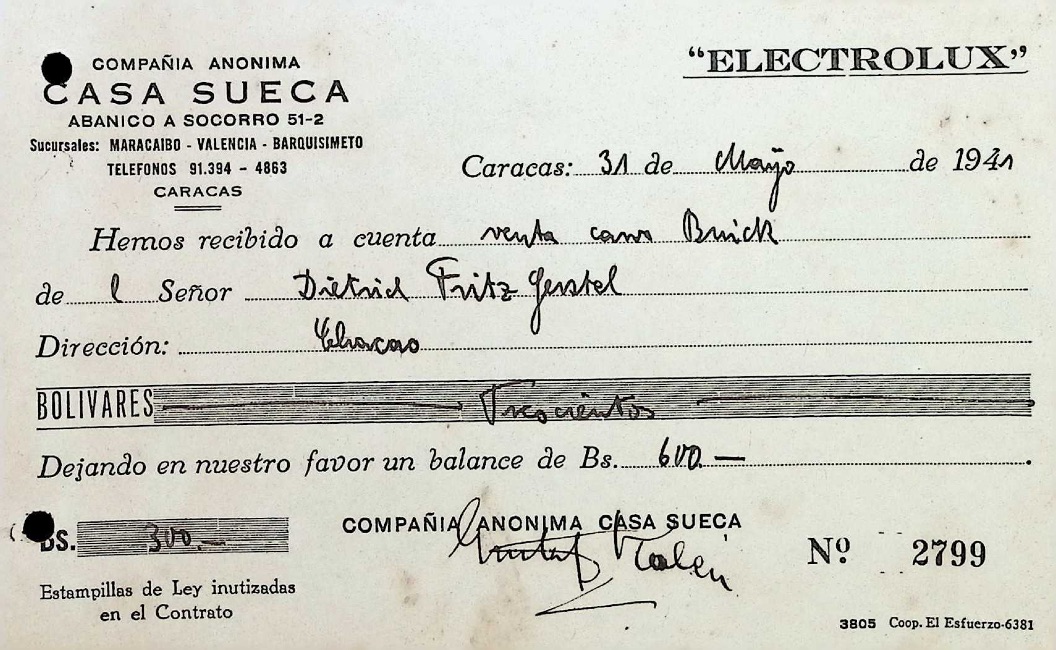
Buick Automobile Purchase Receipt
Proof of payment to the “Casa Sueca” company in Caracas for the purchase of a Buick vehicle—an essential asset for regaining his independent mobility and managing his business affairs.
Letter on the Post-War Period and the Accounting Firm
A pivotal missive to his Uncle Alfred confirming the murder of his parents-in-law in the Holocaust and announcing the sale of the food business due to exhaustion, alongside his decision to devote himself entirely to accounting and auditing.
The MS St. Louis Crisis (May 1939)
While the Gerstels were in Havana, this vessel, carrying over 900 Jewish refugees, was turned away by both Cuba and the United States, forced to return to Europe. This event intensified the prevailing panic and fueled Dietrich’s urgent need to leave the island for South America.
World War II (1939–1945)
The global conflict erupted mere months after Dietrich’s arrival in the Americas. Venezuela became a strategic oil supplier for the Allies, triggering an incipient economic boom while simultaneously heightening tensions due to the presence of German U-boats in the Caribbean.
The Holocaust
Between 1941 and 1945, the Nazi regime systematized the extermination of European Jewry. It was during this period that Dietrich’s parents-in-law were deported to Theresienstadt and Auschwitz—tragedies he would only be able to confirm once the war had ended.
The October Revolution in Venezuela (1945)
A coup d’état that overthrew Isaías Medina Angarita, ushering in the “Trienio Adeco.” In his letters, Dietrich makes mention of “days of bombings,” reflecting the local political instability he had to navigate while establishing his business.
Refugees aboard the MS St. Louis
937 passengers. Tragically, 254 of them would later perish in the Holocaust after being forced back to Europe
The Population of Venezuela (1941)
Approximately 3.8 million inhabitants. At the time, it was a predominantly rural nation in the midst of a transformative transition toward urbanization.
Immigration in Venezuela
Between 1939 and 1941, the government of Eleazar López Contreras drastically curtailed Jewish immigration, implementing highly restrictive and selective criteria (favoring agricultural laborers). This context makes Dietrich’s successful entry into the country all the more remarkable.
The Venezuelan Bolívar (1940s)
The exchange rate stabilized near 3.35 Bolívares to the U.S. Dollar. It was an exceptionally strong currency at the time, which provided the purchasing power necessary to import goods and rebuild a life.
Theresienstadt (Terezín)
The ghetto and concentration camp where Ernst Ostberg perished. Approximately 33,000 people died there due to starvation and rampant
Contexto Histórico
Primera Guerra Mundial (1914-1918)
Dietrich nació durante el último año de la guerra, en una Alemania devastada por el conflicto y marcada por la escasez alimentaria.
República de Weimar (1919-1933)
Período democrático en Alemania caracterizado por efervescencia cultural, inestabilidad política y avances médicos significativos, como los del Oskar-Helene-Heim.
Crisis de 1923
Hiperinflación catastrófica en Alemania. Un pan llegó a costar 200 mil millones de marcos. La clase media perdió sus ahorros.
30 de enero de 1933
Adolf Hitler asume como Canciller de Alemania, marcando el fin de la democracia. En marzo se aprueban las primeras leyes antisemitas.
Ley de Restauración del Funcionariado (abril 1933)
Primera ley que expulsó a judíos de cargos públicos y profesiones liberales. Afectó directamente a Walter Gerstel en sus posiciones directivas.
1934: Año de consolidación nazi
Hitler elimina oposición interna y se proclama Führer. Miles de judíos alemanes comienzan a emigrar, aunque muchos aún confían en que “pasará”.
Datos Clave
Población judía en Alemania (1933)
~500,000 personas (0.75% del total)
Judíos en Berlín
~160,000, la comunidad judía más grande de Alemania
Tasa de suicidios judíos (1933-1945)
Aumentó más del 500%
Focomelia
Ocurre en 1 de cada 100,000 nacimientos
Oskar-Helene-Heim
Fundado en 1905, pionero en ortopedia pediátrica

