04
1950–1969
Citizenship, Prosperity, and Family Life
This chapter documents the “Golden Age” of the Gerstel family. It details Dietrich’s acquisition of Venezuelan nationality, his professional consolidation as a business leader, the social milestones of his children, and the lifestyle of a family fully integrated into the modernity of Caracas.
From Refugees to Citizens
On March 19, 1954, the Official Gazette of Venezuela published a decree that transformed the family’s legal standing: Dietrich and Irmgard were granted Venezuelan Letters of Naturalization. After fifteen years of residency, this administrative act definitively ended their status as stateless persons and refugees. They were no longer temporary guests, but citizens with full rights in the nation where they had rebuilt their lives—a milestone that allowed them to envision their future with greater security and deeper roots.
Official Gazette: Decree of Venezuelan Nationality for Dietrich and Irmgard Gerstel
The Prestige of the Gerstel Office
During these two decades, Dietrich’s accounting firm reached its professional maturity, becoming a landmark institution for the German and European communities in Caracas.
Dietrich, referred to in the press as the “Old Master” (Altmeister) of commercial law, earned a reputation for meticulousness and unshakeable ethics. His office, equipped with the modern technology of the era, offered comprehensive services ranging from audits to the incorporation of companies.
Interviews in local German-language newspapers bear witness to his standing: a man who, despite his physical limitations, directed his business with iron discipline and an advanced managerial vision.
Advertisement for Accounting Services and Legal Advisory by Dietrich
Interview Regarding the Dietrich Gerstel Accounting Firm
A Journey of Victory and Family Celebrations
In July 1960, the family took part in an event of immense symbolic weight: a joint trip to New York City. For Dietrich—who had been rejected by U.S. immigration laws in 1939 due to his disability—entering now as a solvent tourist, accompanied by his wife and five children, represented a moral victory over the past.
Upon their return to Caracas, the 1960s were defined by a vibrant social life: the quinceañera galas for his daughters at the Hotel Waldorf and the Club de la Electricidad, where Dietrich, dressed in a tuxedo, presided as a proud patriarch.
Furthermore, the 1967 move to the Prados del Este neighborhood—following the expropriation of their former home due to urban expansion—solidified the family’s social standing in one of the city’s most modern districts.
Historical Documents
Official Decree of Venezuelan Naturalization
Official certification of Venezuelan citizenship for the Gerstel couple, formalizing their full legal integration into the country.
Professional Services Advertisement
An advertisement in the Caracas Anzeiger offering the accounting and legal services of his firm, operating from Quinta Bettina in Sabana Grande.
Feature Report: "A Visit to Dietrich F. Gerstel"
An interview profiling him as a “master” of commercial law, highlighting the modernity, efficiency, and prestige of his organization.
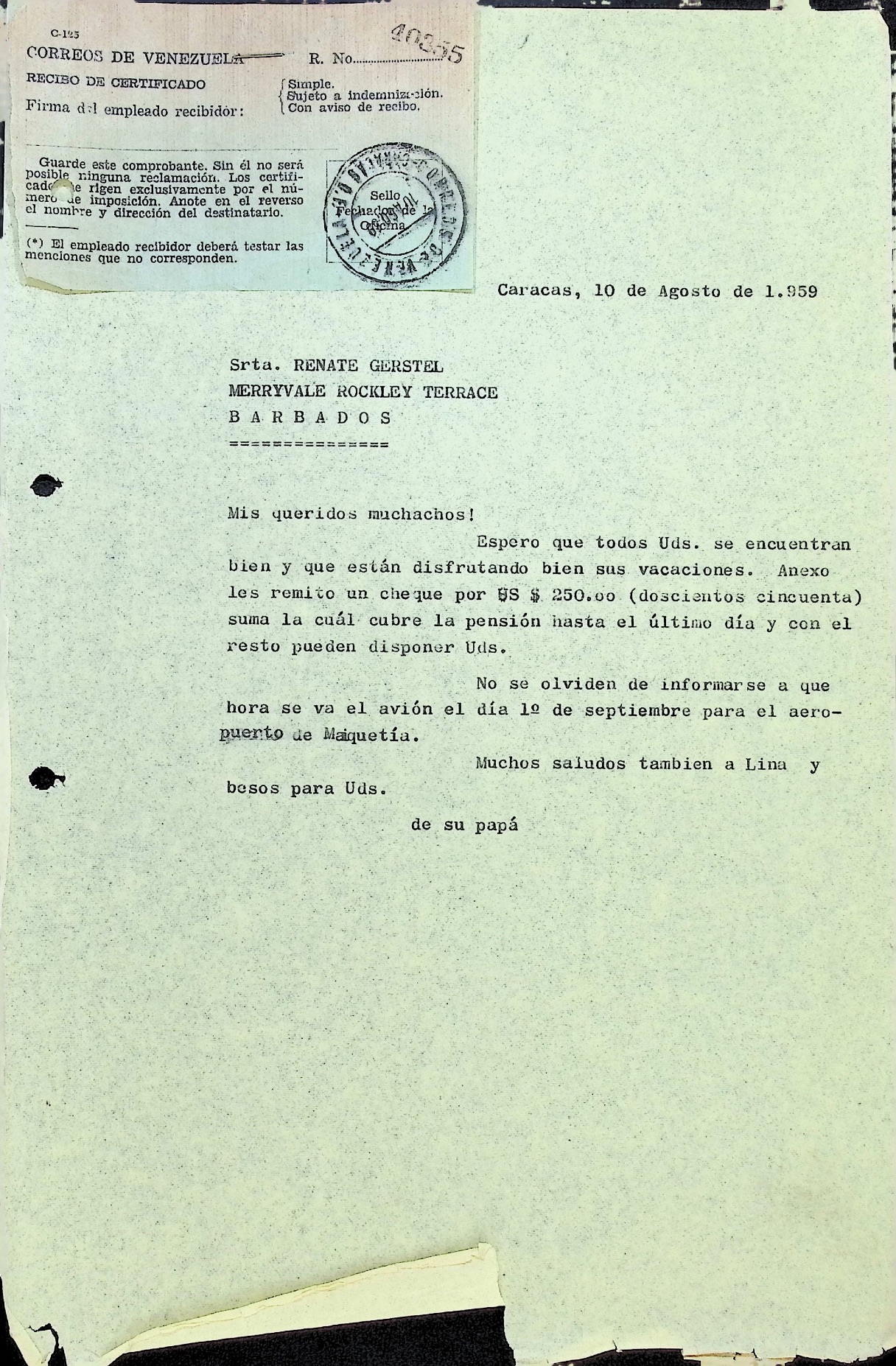
Letter of Support to Renate Gerstel
The remittance of funds to his daughter abroad, evidencing the family’s economic stability and his role as a responsible provider.
The Dictatorship of Marcos Pérez Jiménez (1952–1958)
A period of political repression coupled with an immense urban transformation under the “New National Ideal” (Nuevo Ideal Nacional). Caracas modernized with highways, cable cars, and grand hotels (such as the Waldorf and the Humboldt), providing the backdrop for the economic expansion of the Gerstel Office.
The German Economic Miracle (Wirtschaftswunder)
West Germany’s rapid post-war recovery revitalized international trade. This resurgence benefited Dietrich, who served as both an accounting and cultural bridge for German firms seeking to invest in an oil-rich Venezuela.
Democracy and the Puntofijo Pact (1958)
The fall of the dictatorship and the establishment of the democratic system in Venezuela. Despite initial turbulence, a robust middle class emerged—a social stratum to which the Gerstel family fully belonged.
Commercial Aviation (The Jet Age)
In the 1960s, international travel became accessible to the upper-middle class. The family’s flight to New York in 1960 symbolizes this new era of globalization and freedom of movement.
The Growth of Caracas
The city’s population tripled during this period, surging from 700,000 in 1950 to over 2 million by the late 1960s.
Nationalizations (1954)
That year, thousands of European immigrants were granted Venezuelan citizenship as part of a state policy aimed at full social and legal integration.
Historical Exchange Rate
Throughout nearly this entire era, the U.S. Dollar remained fixed at 3.35 and later 4.30 Bolívares. This stability allowed Venezuelans to travel abroad and build savings in a strong currency.
Prados del Este
A model residential development established in the 1960s, it became the quintessential symbol of status for Caracas’s upper-middle class.
The German Community in Venezuela
By the 1960s, it is estimated that over 5,000 Germans (including German Jews) were actively driving the nation’s commerce and industry.
Contexto Histórico
Primera Guerra Mundial (1914-1918)
Dietrich nació durante el último año de la guerra, en una Alemania devastada por el conflicto y marcada por la escasez alimentaria.
República de Weimar (1919-1933)
Período democrático en Alemania caracterizado por efervescencia cultural, inestabilidad política y avances médicos significativos, como los del Oskar-Helene-Heim.
Crisis de 1923
Hiperinflación catastrófica en Alemania. Un pan llegó a costar 200 mil millones de marcos. La clase media perdió sus ahorros.
30 de enero de 1933
Adolf Hitler asume como Canciller de Alemania, marcando el fin de la democracia. En marzo se aprueban las primeras leyes antisemitas.
Ley de Restauración del Funcionariado (abril 1933)
Primera ley que expulsó a judíos de cargos públicos y profesiones liberales. Afectó directamente a Walter Gerstel en sus posiciones directivas.
1934: Año de consolidación nazi
Hitler elimina oposición interna y se proclama Führer. Miles de judíos alemanes comienzan a emigrar, aunque muchos aún confían en que “pasará”.
Datos Clave
Población judía en Alemania (1933)
~500,000 personas (0.75% del total)
Judíos en Berlín
~160,000, la comunidad judía más grande de Alemania
Tasa de suicidios judíos (1933-1945)
Aumentó más del 500%
Focomelia
Ocurre en 1 de cada 100,000 nacimientos
Oskar-Helene-Heim
Fundado en 1905, pionero en ortopedia pediátrica

