08
1990-2000
The End of an Era
The early 1990s, marked by an official invitation from the Berlin government, the ongoing legal battles over the family’s heritage against the German state, and the gradual decline in Dietrich’s health—which culminated in his death at Quinta Bettina in Prados del Este in 1997—brought to a close a historic cycle of memory and perseverance.
The Invitation from Berlin: An Act of Moral Restitution
After Irmgard’s death, Dietrich faced life as a widower at the Bettina Estate. To ease his loneliness, his daughter Renate moved in with him, offering him support and companionship during this new phase of his life. In 1990, a year after the fall of the Wall, the Berlin government sent an official invitation to its former citizens who had been persecuted by the Nazi regime, inviting them to visit the city as a formal act of historical reparation. Although Dietrich had already traveled to Germany on his own after the war, this marked the first institutional and official invitation he had received from the German government.
Dietrich responded by accepting the gesture, but spoke with complete candor about her physical situation: due to her severe disability and the use of prosthetics, she required first-class travel arrangements—logistical arrangements that the German bureaucracy was unable to guarantee. Although the actual trip never took place, the exchange of letters represented a profound moral restitution.
Letter from Dietrich to the Chancellery of the Berlin Senate (1990)
In the document, Gerstel outlines his basic biographical information, his emigration route in 1939 (Berlin–Havana–Caracas), and the conditions for accepting an official invitation to his hometown.
Half a Century of Perseverance in Preserving Family Heritage
Throughout the 1990s, the processes of restitution and compensation for family properties seized by the Nazi regime continued. By this time, Dietrich’s children—especially Thomas and Graciela—were playing a key role in managing the correspondence and in the legal battle against the lawyers and institutions handling the claims. Although the family had successfully secured some compensation since the end of the war, claims for significant assets—such as the Paretz estate and the land belonging to Permutit AG—remained pending. Thus, what began as an immediate call for justice in the postwar period evolved into an intergenerational effort that mobilized the family for more than half a century, creating a historical record of perseverance and remembrance.
Farewell to a Man Who Left His Mark
In the early 1990s, Dietrich’s health began to decline due to recurring heart and circulatory problems that required lengthy hospital stays. Reports from that time highlighted his remarkable physical resilience in the face of medical adversity, but also the understandable wear and tear accumulated over a lifetime of extraordinary effort and the profound emotional distress resulting from his grief.
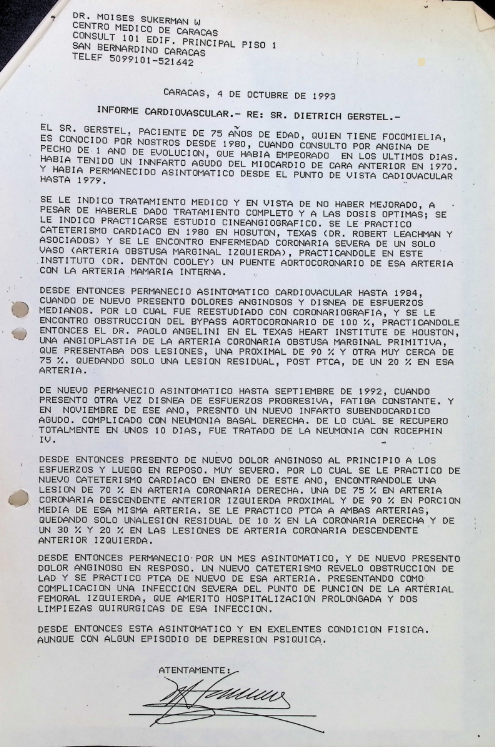
Medical record issued by Dr. Moisés Sukerman at the Caracas Medical Center, certifying his medical treatments, angioplasties, and coronary surgeries performed in Caracas and Houston.
In 1995, after suffering a stroke, his condition became critical. Faced with the doctors’ grim prognosis, his children’s response was unanimous and resolute: to remain hopeful and provide support until the very end. Although his body showed remarkable resilience and managed to stabilize temporarily, the respite was brief; Dietrich fell into a deep coma that lasted eighteen months.
Dietrich passed away in the privacy of his home, at Quinta Bettina, on April 4, 1997, due to chronic kidney and vascular complications. His funeral, held at the Memorial de Bello Campo funeral home, drew a large crowd that paid tribute to his memory. On April 5, he was laid to rest in the family plot at the Cementerio del Este in La Guairita. In the days that followed, the family received hundreds of letters, telegrams, and messages of condolence from relatives, friends, and institutions, while the national press published obituaries paying tribute to a man who left an indelible mark.
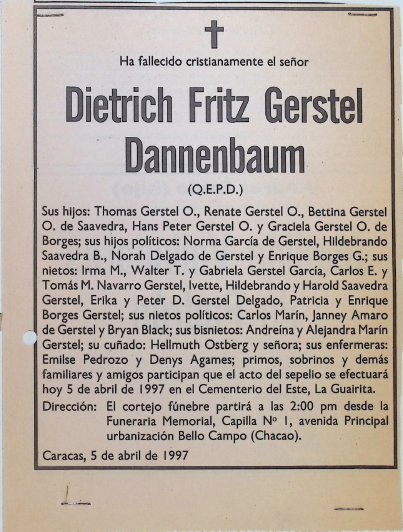
The document provides details about the funeral procession and the members of his immediate family.
German Reunification (1990)
A political process that, on October 3, 1990, reunified the two Germanys following the Cold War. This milestone brought an end to decades of Cold War division and established the country as the economic engine of modern Europe.
Invitation Program for Formerly Persecuted Citizens
In the mid-1990s, this official program brought together more than 30,000 Jewish exiles who returned to Berlin on reconciliation trips. During these week-long official visits, the mayor’s office formally presented them with copies of their birth certificates and family records recovered from the city’s archives.
Property Act of 1990 (Vermögensgesetz)
Enacted after reunification, this law allowed Jewish families in exile to claim property confiscated by the Nazi regime in the former East Germany. The legislation prioritized the physical return of the property and set December 31, 1992, as the deadline for filing claims.
Colapso Administrativo en Berlín (1990)Administrative Collapse in Berlin (1990)
After reunification, the Berlin offices were overwhelmed by more than 80,000 applications from exiles for invitation and restitution programs. This massive demand overburdened the German bureaucracy, making it difficult to manage customized logistical exceptions.
Restitutions Following Reunification
German reunification led to tens of thousands of property claims filed by heirs living in exile. By the late 1990s, this legal process had resulted in cumulative compensation and restitution payments totaling more than 2,500 million euros.
Cardiovascular Mortality in Venezuela
During the 1990s, heart disease and strokes were the leading cause of death in Venezuela. According to official health data, these conditions accounted for more than 25% of annual deaths in the country.