As part of Enrique Borges Gerstel’s effort to revive his grandfather Dietrich Gerstel’s family archive, in January 2026 he embarked on a trip to Germany to visit the key places where the history of his ancestors unfolded. On this emotional journey back to his roots, he was accompanied by his wife, his children, and his mother, who not only shared the journey but also served as an indispensable emotional support in processing the vivid memories of this reunion.
Stumbling Blocks: The Trail of Ernst and Elsa Ostberg
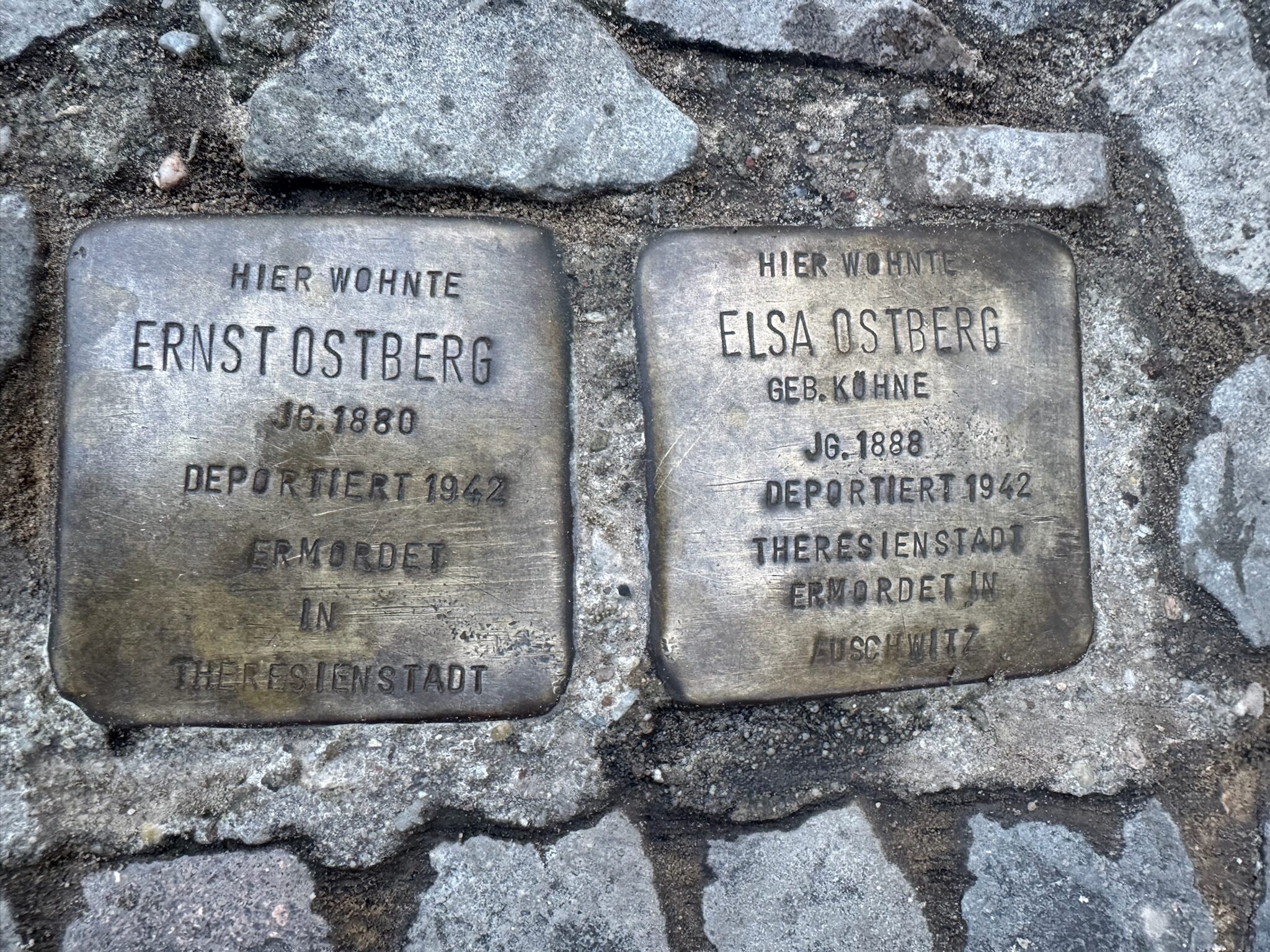
The first stop on the trip for Enrique and his family was to locate one of the tangible remnants of their great-grandparents. Since there are no physical graves or headstones for the family to visit to honor Ernst and Elsa Ostberg, it is deeply comforting to know that their names remain engraved on two Stolpersteine (stumbling stones). These small commemorative plaques are located at Klopstockstraße 9 (now number 14) in the Hansaviertel district: the last home they lived in in Berlin before being deported to the Theresienstadt ghetto in 1942.
Amid a harsh winter that buried the city in snow, the discovery seemed almost impossible. However, in a moment that defied all rational logic, Enrique’s wife, Vivian, discovered a single rectangle of ground miraculously clear in the middle of the white sidewalk. There, sheltered from the winter, the two golden metal plaques shone intact, waiting for the exact moment of their reunion with the family lineage.
Today, as we recover those names from old administrative and historical documents and see them etched into the streets of Berlin, they feel more alive than ever in the present—a confirmation that family history continues to pulse and that the original seed could not be destroyed. Making their names public and visiting this urban tribute marks the beginning of a promise to remember. It is the way in which new generations honor them, vindicate them, and rescue them from oblivion, transforming their legacy into a reliquary of love and an eternal reminder that their lives were not in vain.
Stolpersteine for Ernst and Elsa Ostberg on Klopstockstraße, Berlin, Germany. 2026.
The Reunion in Weißensee: Walter Gerstel's Grave
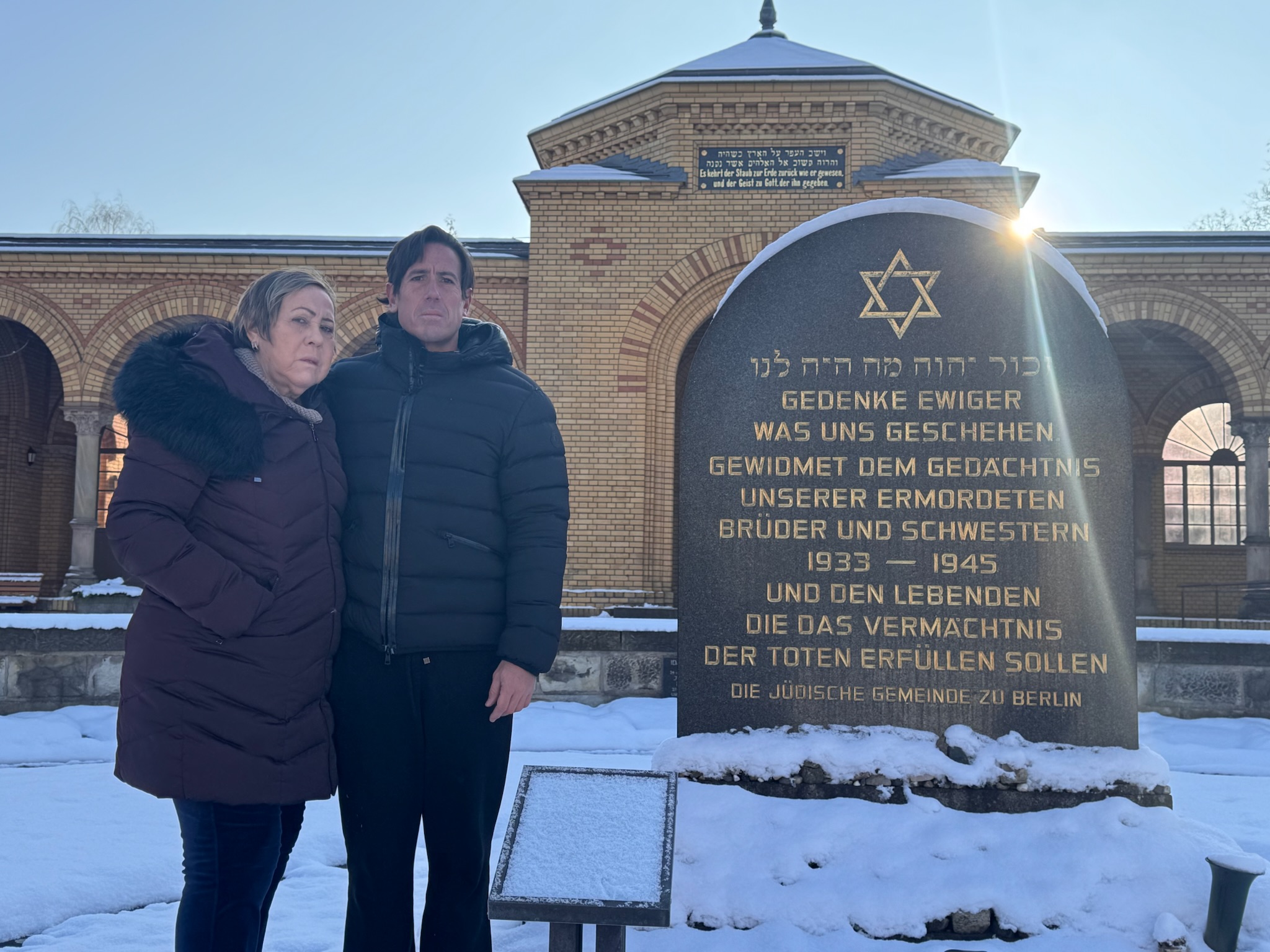
The entrance to the Berlin-Weißensee Jewish Cemetery is marked by the monumental stele at the entrance, erected by the Jewish Community of Berlin. The inscription on the memorial sets forth an explicit mandate in both German and Hebrew: “Remember, O Eternal One, what has befallen us… and the living, who must fulfill the legacy of the dead”. For Enrique, embracing the historical responsibility that this message demands of new generations served as the fundamental prelude to the tour.
Enrique Borges Gerstel and his mother, Graciela Gerstel, standing next to the memorial to the victims of National Socialism at the Jewish Cemetery in Berlin-Weißensee, Germany. 2026.
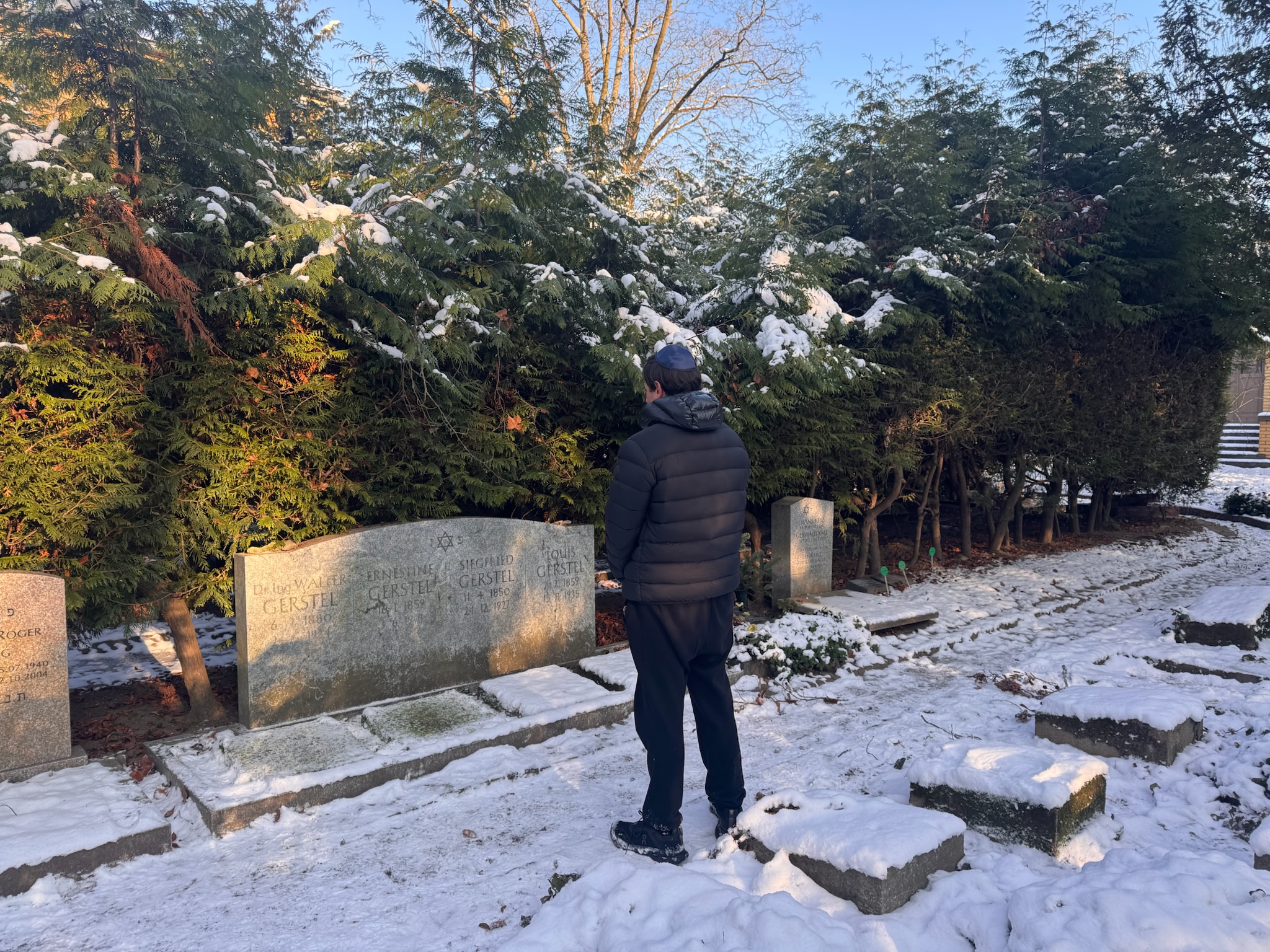
Under a blanket of winter snow, the family made their way through this silent cemetery to the grave where the ashes of their great-grandfather, Walter Gerstel, rest alongside those of his parents, Siegfried and Ernestine, and his uncle Louis. Standing before that solid headstone, the family name ceased to be an abstract concept and became a tangible, real presence.
Being there brought to the surface deep certainties that distance makes impossible to grasp; in that moment, his lineage took on a tangible dimension amid the Berlin cold. For Enrique, this moment was not meant to heal a wound, but rather to make sense of their shared history: by locating Walter’s final resting place, a part of his own heritage found its exact place in the world.
Enrique Borges Gerstel stands in front of the grave of his great-grandfather, Walter Gerstel, at the Jewish Cemetery in Berlin-Weißensee, Germany. 2026
Tiergartenstraße 25: The Dispossessed Home in Berlin
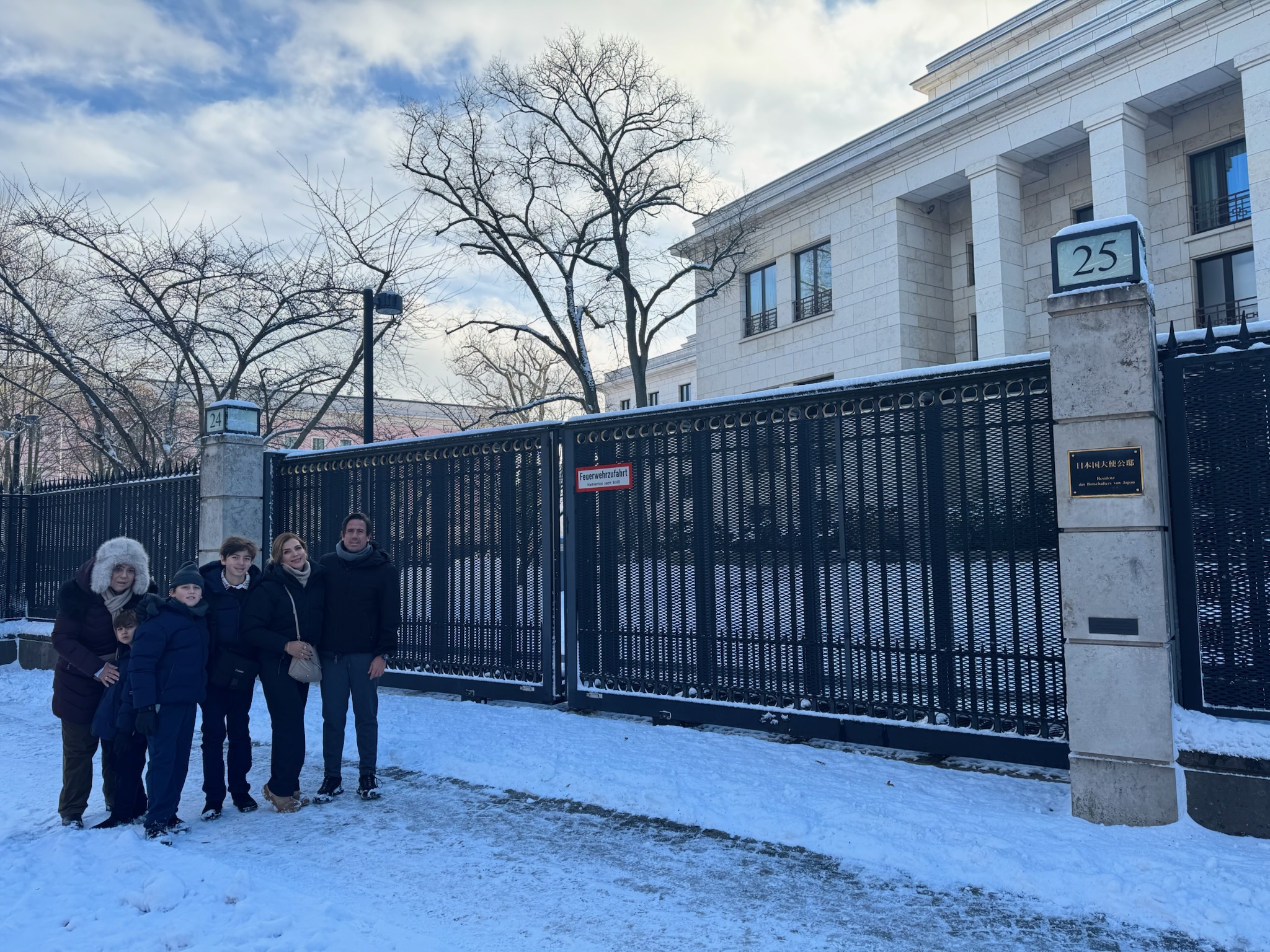
During their stay in Berlin, Enrique and his family stopped in front of the imposing neoclassical building that now houses the Japanese Embassy. The act of gazing at the number 25 on Tiergartenstraße, engraved in stone, went beyond simply verifying a fact from the archives; it was a moment to reflect on the deep roots of his own lineage in a land from which they had been dispossessed.
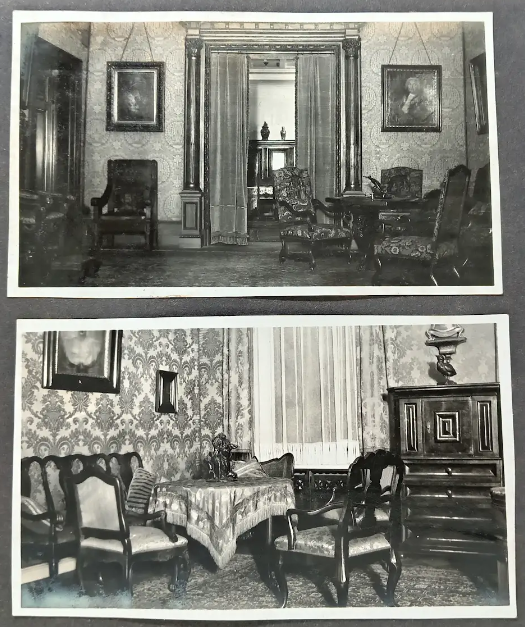
Long before persecution policies forced the family into exile, this address was home to a stately villa with more than twenty rooms that belonged to their great-great-grandparents, Jacob and Hedwig Dannenbaum, who purchased it between 1909 and 1910. Later, in 1927, the residence passed to their great-grandparents, Walter and Lili Gerstel, who furnished it with pieces of great historical and artistic value, turning it into the center of family life.
Interior rooms of the family home at Tiergartenstraße 25, Berlin, Germany. 2026.
That home, filled with everyday life and splendor, came to an abrupt end in 1937, when Lili Gerstel was forced to sell the property under systematic pressure from the Nazi regime before leaving Germany. As they stood before its gates, three generations of the family managed to connect the splendor of the present with the living memory of their ancestors, restoring a human presence to the place where attempts had been made to erase their history.
Enrique Borges Gerstel and his family in front of the Japanese Embassy at Tiergartenstraße 25, Berlin, Germany. 2026.
Return to Paretz: The Gerstel Estate
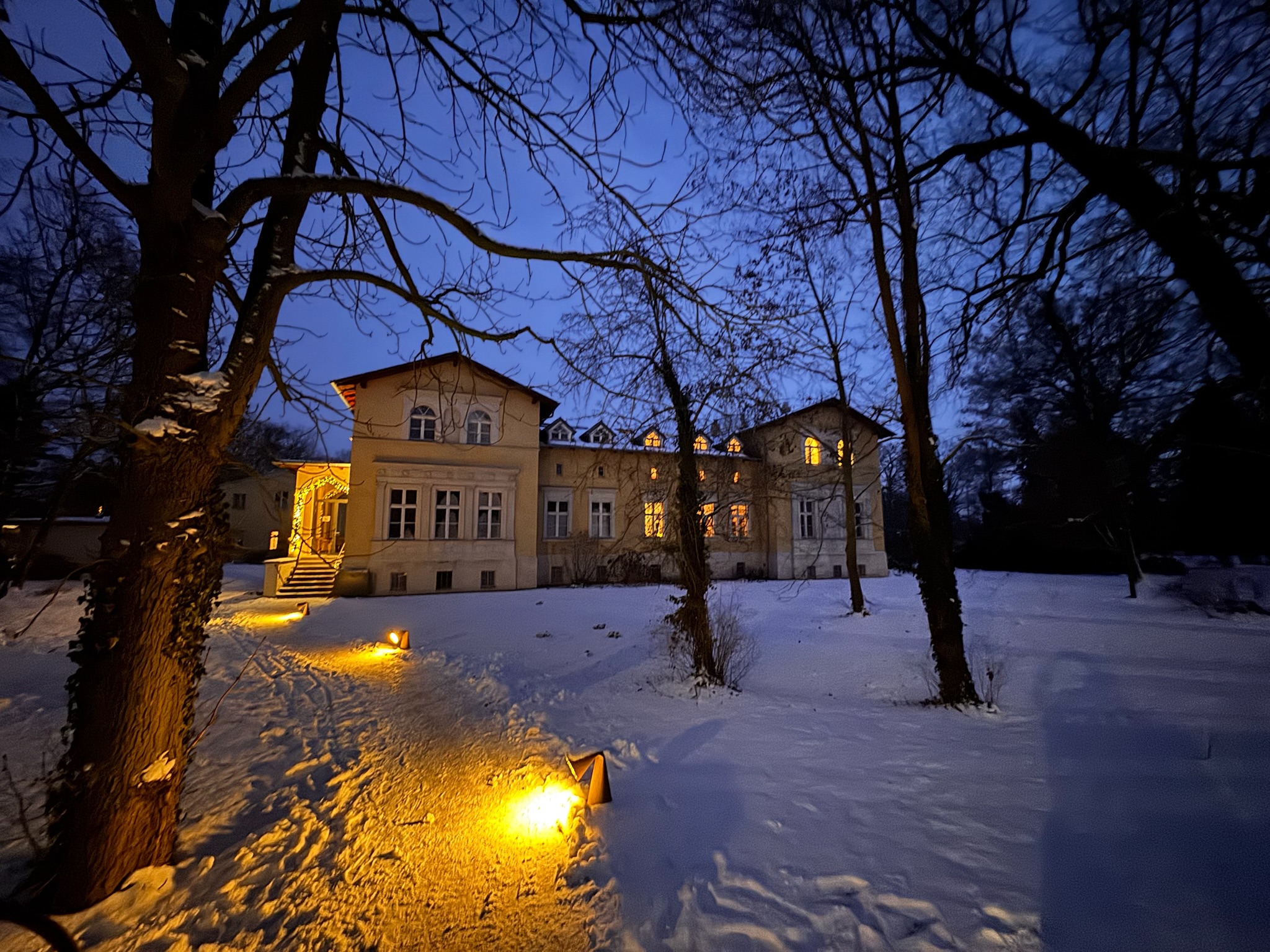
Located on the outskirts of Berlin, the Paretz estate served as the rural retreat where Dietrich Gerstel and his siblings spent their childhood before the outbreak of the war. Far from being an idealized postcard image, family records and correspondence describe a vibrant, self-sustaining estate: a home with draft horses, a mindful household economy, and an innovative water system designed by Walter Gerstel himself. Paretz embodied a practical and respectful relationship with nature; it was a living testament to the Gerstels’ identity and deep roots.
Main facade of Paretz. Brandenburg, Germany. 2026.
Reaching the site in the dead of winter, amid temperatures of ten degrees below zero and discrepancies in the geographic coordinates, seemed to bring the search to a halt. However, amid the vast silence of the landscape, the providential intervention of a local resident who was familiar with the Gerstels’ legacy made it possible to overcome the setback. After guiding Enrique and his family precisely to the exact spot, the man disappeared without a trace, paving the way for their long-awaited encounter with the property.
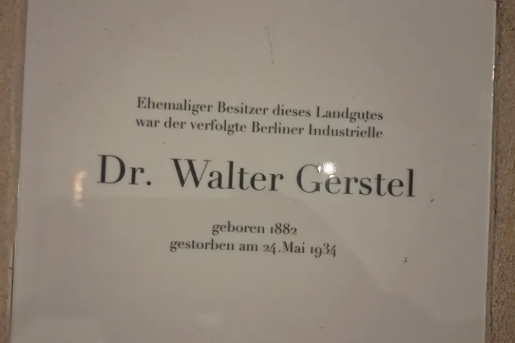
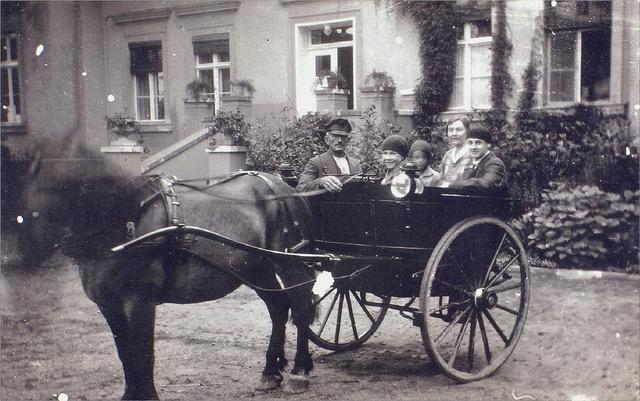
The current house, purchased from the German government and preserved with remarkable care by its current owner, Úrsula Münstermann, welcomed them not as strangers, but as the long-awaited link. Münstermann, who had even installed a commemorative plaque in honor of Walter Gerstel, shared her living space with them and, later, valuable archival images. Among the documents, the discovery of a photograph of the young Dietrich smiling on a wagon on the estate served as an intimate and powerful confirmation: in Paretz, the past had not only been preserved with dignity, but memory had been waiting for the exact moment to be fulfilled.
Commemorative plaque in honor of Walter Gerstel in Paretz, Brandenburg, Germany. 2026.
Dietrich Gerstel (wearing a cap) in a carriage in Paretz (courtesy of Úrsula Münstermann, 2026). Brandenburg, Germany. c. 1920.
Terezín: Restoring the Memory of Ernst Ostberg
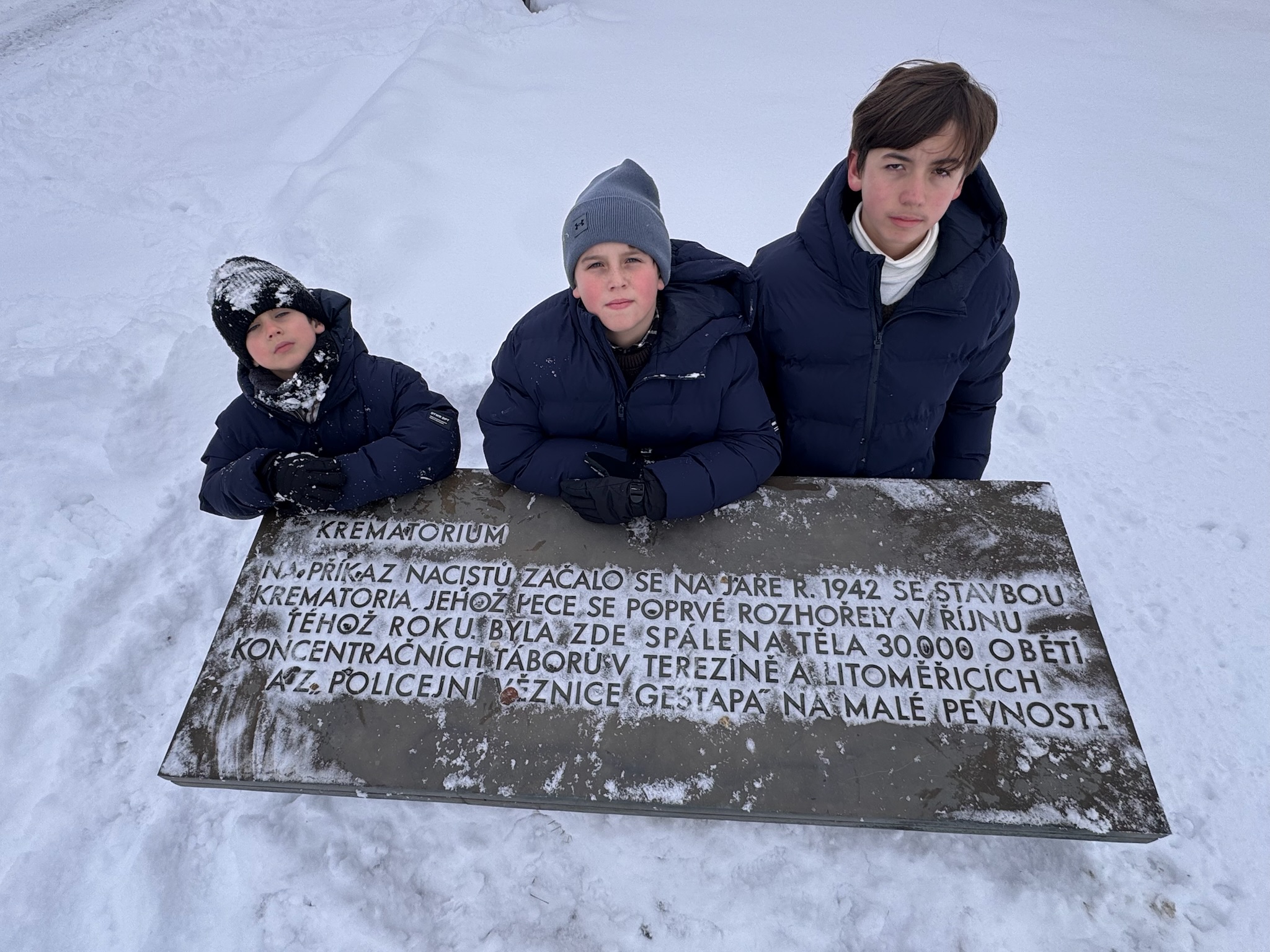
The journey of remembrance continued at the Terezín Ghetto Museum. There, after explaining the purpose of our family research, the museum staff provided maps and information about the places where Ernst and Elsa Ostberg had lived, as well as the exact location where his ashes were interred—he had died in the ghetto in 1943 from malnutrition. The visit extended beyond the ghetto walls to the crematorium area and the Terezín National Cemetery, whose headstones remained covered by thick winter snow, and then proceeded to the Magdeburg Barracks in search of the residential records documented in the official records.
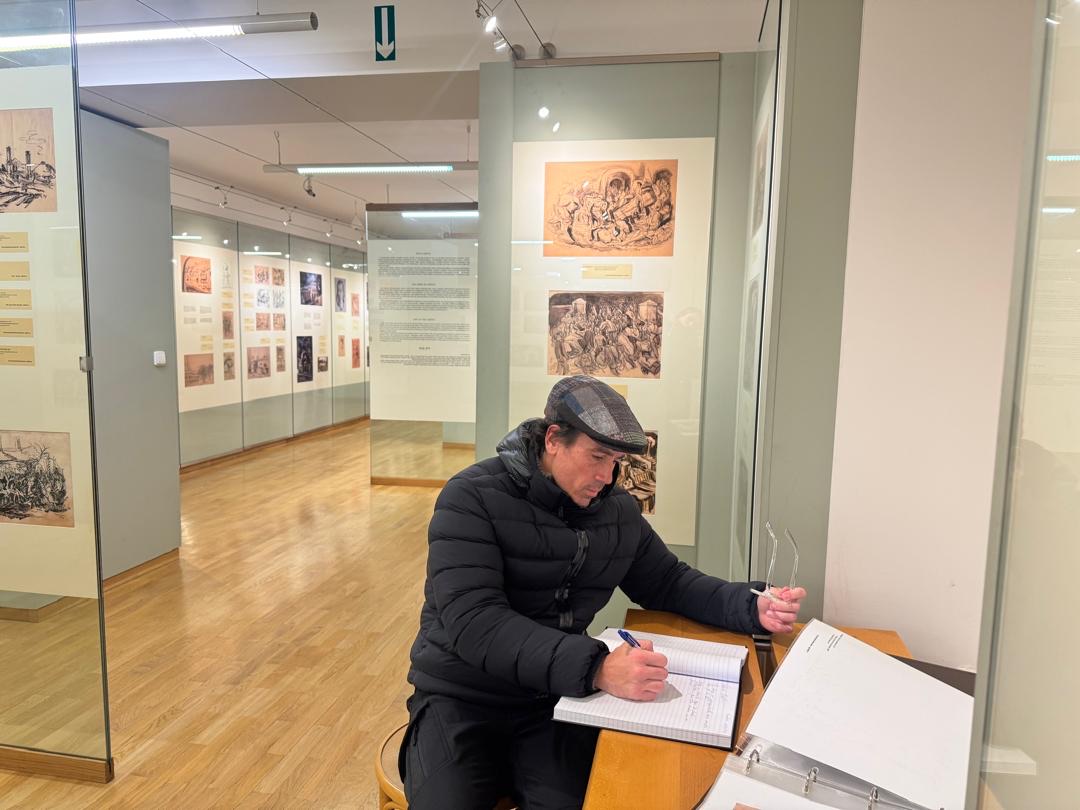
Beyond the horror documented in the archives, the family’s visit to the former ghetto served a strictly human purpose: the recognition of their origins. In one of the museum’s galleries, Enrique left a written record of this act of material and spiritual restitution, freeing his great-grandfather’s memory from the burden of tragedy to restore the value of his existence.
By preserving the name of Ernst Ostberg for future generations, the journey fulfilled its fundamental purpose. The presence of his children at the site confirmed that the line of succession remains intact and that the historical truth has finally been passed down, free of trauma, as a link to life and continuity.
Enrique Borges Gerstel writing a note during his visit to the Terezín Ghetto Museum, Czech Republic. 2026.
Enrique Borges Gerstel's children stand next to the commemorative plaque in front of the crematorium at the Terezín Ghetto, Czech Republic. 2026.
Auschwitz-Birkenau: The Memory of Elsa Ostberg Kohne and Her Sisters
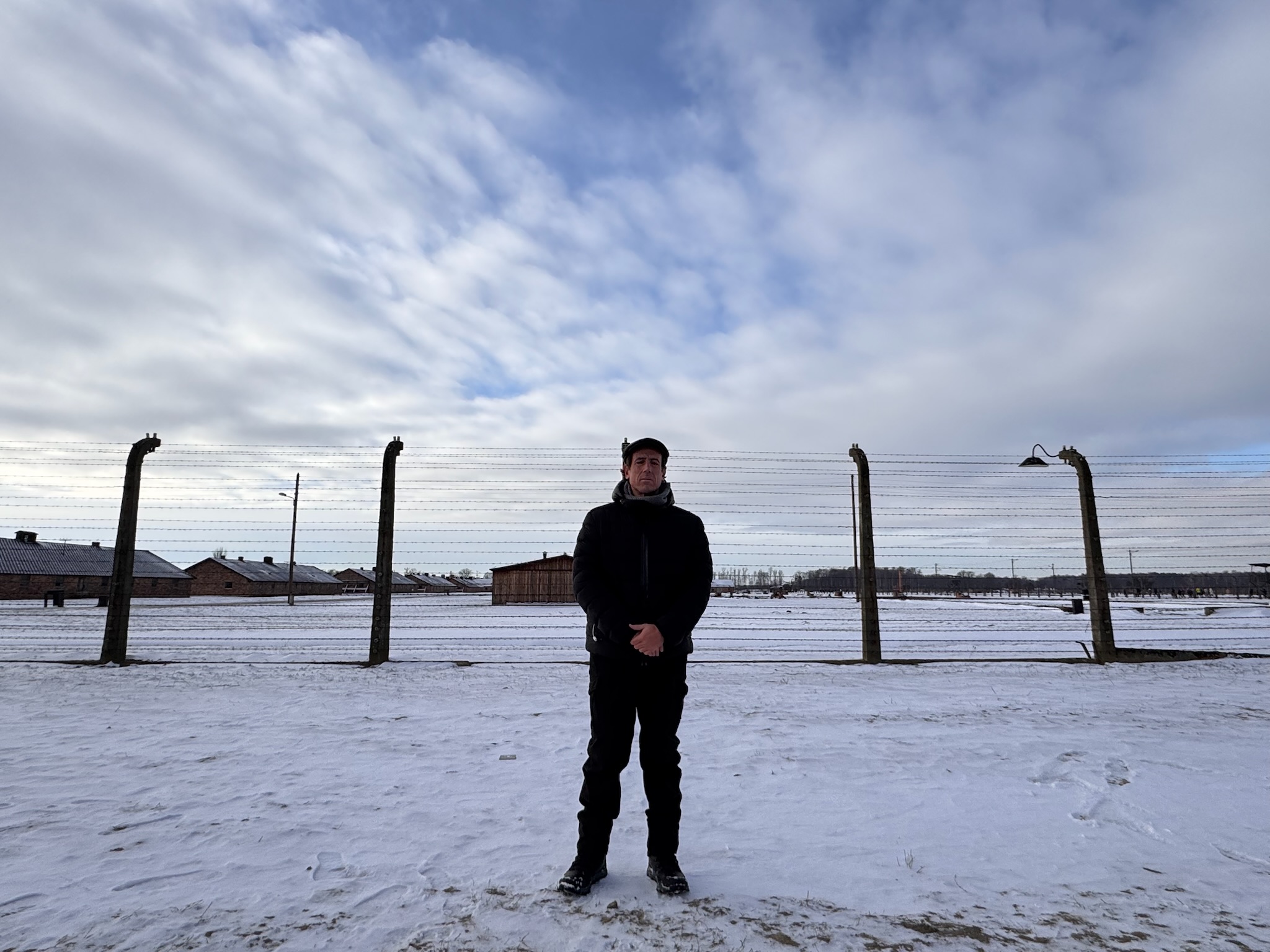
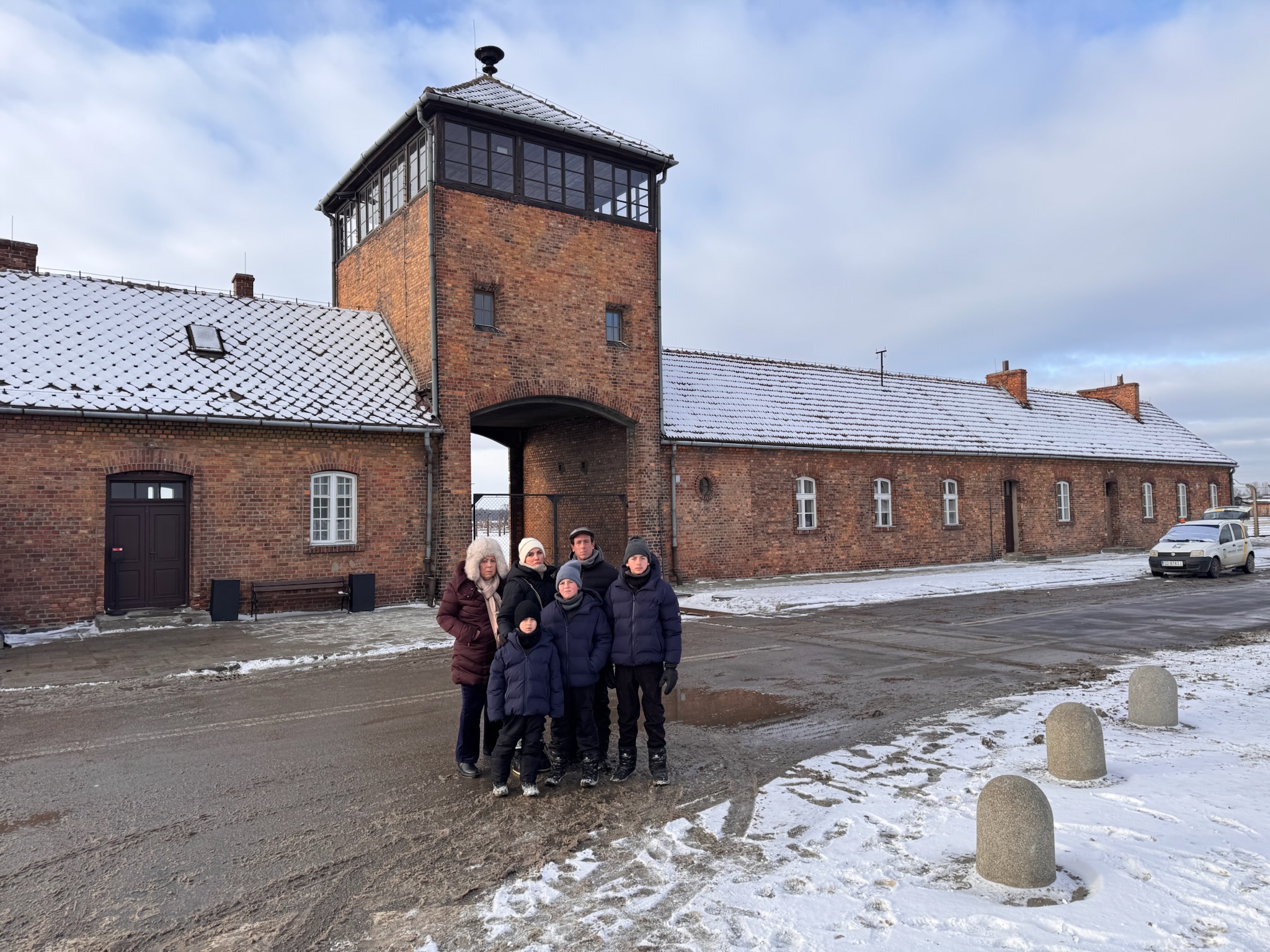
From the Polish city of Kraków, the memorial tour continued to the Auschwitz-Birkenau Memorial and Museum. The visit to this site was not conceived as a conventional tour, but rather as a solemn act of remembrance for Elsa Ostberg and her two sisters, Margot and Charlotte Kohne—three women from the same family whose lives were cut short by the same system in this region. After passing through the entrance to Auschwitz I beneath the metal inscription Arbeit macht frei, Enrique and his family walked in respectful silence through the brick structures that today house the physical evidence and confiscated everyday objects, before proceeding to Auschwitz II-Birkenau. At this mass extermination camp, located three kilometers away, they walked past the wooden barracks and the ruins of the crematoria.
Enrique Borges Gerstel at the former Auschwitz II-Birkenau extermination camp, Poland. 2026.
Set against the backdrop of the old countryside, the search for historical truth took on a deeply unifying meaning. The purpose of the family’s presence at the site was not to question the tragedy or to attempt to assimilate the pain of others, but rather to refuse to look away and to affirm their existence: the journey of three generations walking together through the same territory demonstrated that the system of extermination had failed, as it was unable to erase all traces of their descendants.
As they left the memorial, the journey cemented its purpose in the future, not in the past. The names of Elsa, Margot, and Charlotte were definitively woven into the living fabric of a story that continues, transforming the memory of the victims into a testament to enduring life. The attentive presence of the younger generations imbued the family’s collective memory with a sense of conscious living, reaffirming that while horror belongs to universal history, the family belongs fully to the future.
Enrique Borges Gerstel and his family at the main entrance to Auschwitz II-Birkenau, Poland. 2026.
The Hansaviertel Urban Memorial
During the deportations of 1942, the Hansaviertel district was stripped of its large Jewish community. When the Stolpersteineproject began, Klopstockstraße became one of the areas in Berlin with the highest concentration of these plaques, transforming the sidewalks of the former neighborhood into an urban memorial against forgetting
Berlin-Weißensee Jewish Cemetery
Opened in 1880, Weißensee is the largest Jewish cemetery in Europe, with more than 115,000 graves. During the Nazi era, the cemetery survived almost intact because its administration remained under community control, even serving as a clandestine refuge and a secret repository for historical archives.
Transformation of Tiergartenstraße
In the fall of 1938, this plot of land was cleared as part of the Nazi plan to redesign Berlin (Welthauptstadt Germania). That same year, construction began on the Japanese Embassy, a strategic architectural project intended to strengthen the regime’s geopolitical alliances.
Stumbling Stones in Berlin
Within the city limits of the German capital, the Stolpersteine project has already surpassed 11,800 commemorative plaques placed on the sidewalks.
Suicides in the Face of Deportation
Zwischen 1933 und 1945 wurde der Jüdische Friedhof Berlin-Weißensee zur letzten Ruhestätte für 1.907 Berliner Juden, die sich angesichts der nationalsozialistischen Verfolgung oder der drohenden Deportation das Leben nahmen.
Demographic Imbalance in the Ghetto
Theresienstadt held more women than men (75,000 compared to 66,000) due to the mass deportation of elderly women. Toward the end of the war, the forced deportations of men left the camp with a population that was 70% female.
Official Prisoner Registry
Of the total of 1.3 million people sent to Auschwitz, only about 400,000 prisoners were officially registered and tattooed with a number on their arm.